



















- Home
- About Us
- Sailing Courses
- Powerboat Courses
- SLC - International License
- Yacht Vacations
- Find an On-Water Instructor
- Practical Courses
- Fighting Childhood Cancer
- Free Courses Signup
- Student Benefits
- Gift a Sailing Course
- Sailing Opportunities
- Sailing Licenses and Certifications
- About the Sailing Certifications
- Sailing Blog & Helpful Articles
- NauticEd Podcast Series
- Yacht Charter Resources
- School Signup
- Instructor Signup
- Affiliate Signup
- Boat Sharing Software
- Sailing Industry Services
- Support & Contact
- Newsroom
- Privacy Policy

Qualified Crew Member | Online Sailing Course

Become a Competent Crew Member
The Qualified Crew online course equips you with the knowledge and theory required to thrive as a valuable crew member on any sailing vessel. From mastering terminology to systems to understanding key sailing roles and responsibilities onboard, our comprehensive course prepares you to embark on unforgettable sailing adventures as a crew with skippers, friends, and family.
Estimated Time: 7 hours
Price: $45 $37.50
Take the Qualified Crew Member online sailing course to learn how to sail and become a valuable crew member on small and large sailboats. This comprehensive course covers everything you need to know to contribute effectively when sailing with friends or becoming part of a sailing team.
From basic sailing terminology to sail trim and maneuvering, this course will provide you with the necessary knowledge and skills to become a competent crew member. You will learn how to assist with sailing, and navigation, understand weather patterns, and handle emergency situations.
Whether you are new to sailing or looking to improve your skills, this course will help you become a great crew member and an asset. So enroll now and start your journey towards becoming a competent and valuable crew member on the water!
Topics covered in this Qualified Crew Member Online Sailing Course
- Weather and Sea Conditions
- Electrical Systems
- Auxiliary Power
- Rigging
- Standing and Running Rigging
- Rules of the Road
- Slip Departure and Return
- Sailing
- Communications & Navigation
- Anchoring and Mooring
- Coping with Emergencies
We guarantee both your satisfaction AND Lifetime access to any sailing course you buy from us
More about this Qualified Crew Member Sailing Course
- Learn to crew sailboats with this comprehensive online sailing course, and contribute as a crew member on a modern 30-50 ft sailboat
- This Sailing Course takes approximately 7 hours of total time to complete
- Take as long as you need to complete
- Return as many times as you like to review
- Take the online test as many times as you like
- Adds the Qualified Crew Member Endorsement to your Sailing Certificate
- View an excerpt of the Qualified Crew Member Sailing Course
This is an ONLINE course and tests viewable in your browser window.
Price: $45 $37.50
Not convinced yet that online sailing courses are cool? Visit our fully interactive and completely free Basic Sail Trim Sailing Course. You'll see why online e-learning is SO MUCH BETTER than a boring old Book.
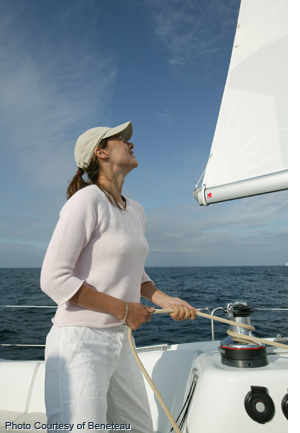
Upon completion, you will feel confident in your ability to understand the workings of a sailboat and enjoy contributing as a knowledgeable crew member. There are tips on how to hold a straight course when at the helm, sail trimming, rules of the road so you're not second-guessing who has to give way, and just what the heck that blue line does.
Once you log 10 sailing days in your FREE NauticEd Online Logbook, you'll be awarded the NauticEd Qualified Crew Member Sailing Certificate. Alternatively, you can shortcut this to 2 sailing days logged by getting practical competency training and sign-off through an accredited NauticEd Sailing Training School.
Are you ready to confidently contribute to the operations of a sailboat? Sick of not REALLY understanding? Then let's get started by registering now!
Please note: If you're considering doing more than crewing on a sailboat then we recommend that you jump right in and take the Skipper Course instead. If you've still got questions about NauticEd, the courses, and/or the sailing certifications, just contact us via email or phone we're happy to help.

By Grant Headifen
NauticEd Global Director of Education
View Qualified Crew Member Course excerpt
Student Reviews
Christopher O.
2026, 12 Sep. 13:35
thorough
Daniel P.
2026, 09 Jul. 23:23
Visuals
Bryan S.
2026, 02 Jul. 15:33
good overview and introduction of key concepts
Carolyn C.
2026, 26 May. 19:50
Great course! It was easy to understand and move through the segments.
Debra M.
2026, 13 May. 01:05
The course covers all aspects of a crew member’s responsibilities .
Kevin L.
2026, 28 Apr. 21:37
It was very comprehensive, a great introduction to the world of sailing.
Mary P.
2026, 22 Mar. 20:15
This course is by far the easiest I have completed with NauticEd. But, it was great review from some of the other courses and has reinforced my learning.
Bern E.
2026, 22 Mar. 18:04
This is a good course if you haven't already done and completed Basic Sail Trim, Navigation Rules for Sailing and Intro to Sailing. This course covers most of what is in this course. There was some new content but mostly it was a refresher.
Ryan S.
2026, 18 Feb. 14:16
Everything was awesome!
Alexander G.
2026, 26 Jan. 19:56
If this is your first course its a nice place to start. It is good general knowledge.
Christopher C.
2026, 20 Jan. 21:38
Great beginner's course.
David T.
2026, 10 Jan. 20:25
Being aware of need to provide details at times.
List Price: $37.50
Excerpt from the course
Expand Excerpt from the courseModule 4 - Rigging -Excerpt
Unfurling or Raising the Sails
The Captain has motored your vessel from the slip into open water and is now ready for you to unfurl the sails. The procedures for unfurling sails are reasonably standardized; however, every sailor will, over time, develop their own routine.
On modern sailboats, main sails are commonly stored – furled – either by being:
* Lashed onto the boom
* Rolled into the mast.
* Rolled onto the boom
There are many opinions as to which is the preferred method, but for now, you will find that each has its pluses and non-pluses. Sailing is rife with opinions that add greatly to the excitement of this sport.
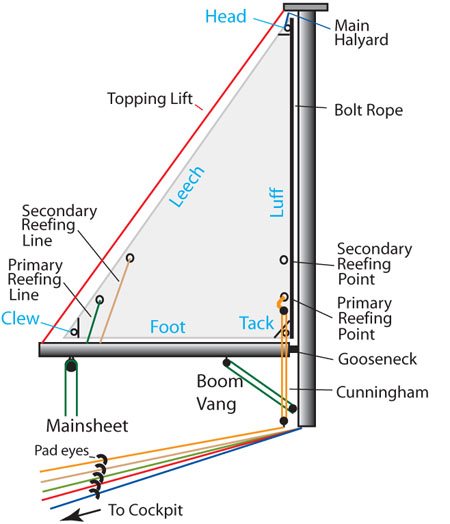
The following diagram is a reminder of the nomenclature of the sails and related thingys.
Module 5 - Rules of the Nautical Road - Excerpt
In the video below, you can see two sailboats on a collision course. The sailboat on a port tack correctly changes course to avoid the sailboat on a starboard tack. The port tack boat also could have turned to starboard to duck in behind the other boat. However, in this case, it chose to tack. The decision to tack or duck is up to you.
Module 7 - Tacking, Jibing and Sail Trim - Excerpt
Which maneuver you perform, tacking or jibing, depends entirely on the circumstances. Select carefully. Jibing has more potential for accidents, including equipment failures.
Wind Direction
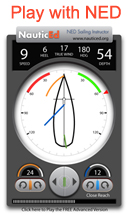
The interactive sail trim game "NED" developed by NauticEd, greatly enhances your understanding of the way the sails should interact with the wind and the boat. Spend some time here now playing with NED. The mystery of setting the sails according to the wind will be completely gone after you've played this interactive game.
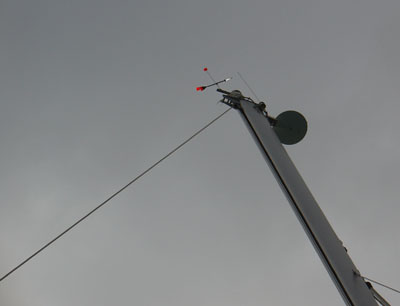
So just how do you tell the wind direction so that you can trim the sails properly? There are 3 ways, the first is very rudimentary but works every time. Simply turn your head until you hear the wind in both ears. Wherever your nose is pointing is the direction the apparent wind is coming from. The second is to look aloft. At the top of the mast is usually a wind vane telling us exactly the direction of the apparent wind.
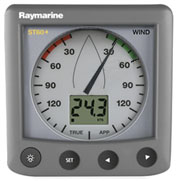
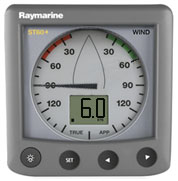
The third is a modern electronic method. A wind meter instrument points in the direction of the wind. The following are photographs of actual wind meters used on boats. It also gives us the wind velocity. Via the electronics, the meter is able to give us both true and apparent wind directions and velocities. In the first photograph, the wind meter indicates that the true wind speed is 24.3 knots and the wind direction is coming from 30 degrees of the starboard bow. The boat then is "on starboard". The second meter indicates a true wind speed of 6 knots from 90 degrees off the port bow. The boat is "on port". If these boats were on a collision course, who would give way?
Fine Trimming
Knowing the direction of the wind allows us to know approximately how to set the sails but it is the fine tuning that will get you going your fastest. As explained above, the sail must be operating at its peak efficiency. This is found by letting the sail out until the luff of the sail just begins to fold in or flap and then taking that slack back out by slightly tightening the sheet. A crew that is vigilantly aware of sail trim and acts accordingly to each wind gust, wind directional change, or boat heading change will win the day and score points with the skipper.
Once a crew member is comfortable setting the sails using the method above, further fine trimming can take place by using the telltales on the sail. The telltales on a boat moving 120 degrees off the wind or less should be flowing smoothly on both sides of the sail. Fluttering or back-winded tell tales indicate a turbulent flow of air on that side of the sail. Thus, pull the sail sheets in or let them out accordingly. If the INNER telltales are fluttering pull the sheet IN. If the OUTER tell tales are fluttering, let the sheet OUT.
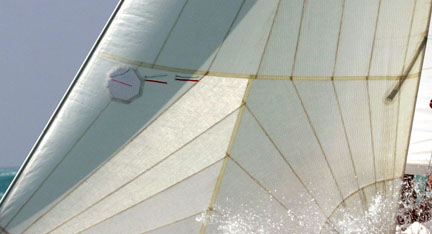
Photo courtesy of Bob Grieser
Other sailing courses that you might enjoy:
Trusted by the world's leading sailing companies
From our students
4.9 out of 5 average across 75,226 student course ratings.
-
"I liked that there wasn’t pressure to rush. I could actually understand what I knew and what I still needed to work on."
Jamie, first-time boater
-
"By the time we chartered, I felt prepared instead of just approved. That made all the difference."
Alex, preparing for bareboat charter
-
"NauticEd helped me see boating as a skill I could build, not something I had to pass or fail."
Morgan, new boat owner