


















- Home
- About Us
- Sailing Courses
- Powerboat Courses
- SLC - International License
- Yacht Vacations
- Find an On-Water Instructor
- Practical Courses
- Fighting Childhood Cancer
- Free Courses Signup
- Student Benefits
- Gift a Sailing Course
- Sailing Opportunities
- Sailing Licenses and Certifications
- About the Sailing Certifications
- Sailing Blog & Helpful Articles
- NauticEd Podcast Series
- Yacht Charter Resources
- School Signup
- Instructor Signup
- Affiliate Signup
- Boat Sharing Software
- Sailing Industry Services
- Support & Contact
- Newsroom
- Privacy Policy

Skipper Large Sailboat | Online Sailing Course
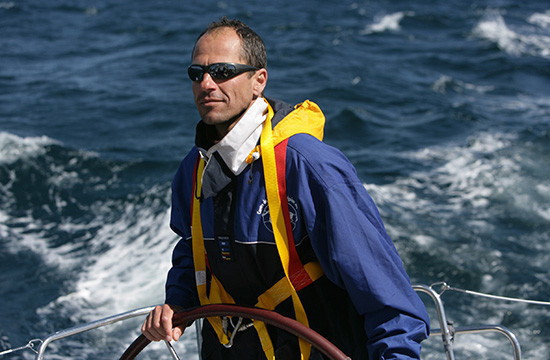

Learn to Skipper Sail Large Sailboats (26 - 56 FT)
This online sailing course offers a comprehensive curriculum for beginner to intermediate sailors skippering large keelboats 26 ft (8 m) and above in near-shore, moderate conditions. Built for serious adult sailors—owners, charterers, and experienced crew stepping into the skipper role—it gives you a clear, no-fluff approach for calm and repeatable control of your sailboat.
Sailing a large keelboat is an amazing experience: more stability and safety, extra space and comfort for extended sails, greater range and capabilities, and stronger performance under sail. With these advantages comes a responsibility to learn big-boat handling under sail and power, weather, docking, and the myriad of onboard systems that a large sailboat demands.
✓ Crisp animations and clean visuals that make complex topics obvious
✓ Pairs perfectly with on-water coaching—find sailing lessons near you via our international instructor network
✓ Recognition on your free NauticEd sailing resume
✓ Lifetime access, including free updates online or in the NauticEd App
✓ 30-day Money-Back Guarantee
Estimated Time: 20 hours
Price: $139 $125.00 (or $115 with the Skipper Rank bundle of sailing courses)
Bonus: All NauticEd sailing students receive the free Basic Sail Trim and Nav Rules courses, free eLogbook and Boating Resume, and special discounts from our industry partners. What's included >
What Students Say
✨AI generated from student reviewsStudents consistently call this a comprehensive, no-fluff course that’s “very complete,” well-structured, and packed with clear explanations, diagrams, and helpful videos/VR—often described as tougher (in a good way) and more in-depth than other programs they’ve taken. Many use it as a serious refresher after years on the water and report a measurable confidence boost, especially when tying together rules, systems, navigation, docking, and emergency decision-making. Reviewers praise the practical focus, the “why behind the what,” and the way testing feedback cements understanding. The consensus: it’s demanding, engaging, and exceptionally well presented—worth taking early in your journey or when stepping up to larger keelboats, with lifetime access making it a valuable reference long after completion.
Why Take the Skipper Large Sailboat (Keelboat) Course?
Sailing a large 26-56 ft sailboat opens an entirely new level of sailing adventures. While many sailing skills and principles are universal, sailing larger sailboats (i.e., “keelboats”) requires additional knowledge and skills to handle the increased power, speed, and weight, as well as the myriad of helm, engine, and system options.
The reward is sailing faster, further, and in diverse weather conditions. In many ways, being on the water on a large sailboat is the ultimate freedom! You’re only limited by how well you develop the knowledge and skills to handle a large boat. This course is designed to give you the confidence and know-how to sail and manage a 26-56 ft keelboat, letting you enjoy the freedom, safety, and excitement that come with big-boat sailing.
This course is also a cornerstone of practical training with a qualified NauticEd instructor as well as a requirement for bareboat chartering certification and licensing, and a precursor for Catamaran training.
This Course is Perfect for You If:
- You're a beginner or intermediate sailor who wants to skipper large keelboats and coastal cruising.
- You’ve sailed before but want a modern, no-fluff online sailing course to refresh and advance your skills.
- You’re planning a bareboat charter and want to begin pursuing bareboat charter certifications and licensing.
- You’re an owner who wants confidence with electrical and diesel systems, not just sail and boat handling.
Your enrollment includes lifetime course access, recognition on your free NauticEd sailing resume, and a complete satisfaction guarantee.
What You'll Learn in Skipper Large Sailboat (Keelboat)
The Skipper Large sailboat online sailing course is designed to teach you all the theory, knowledge, and strategies necessary to safely and competently sail large sailboats (keelboats) that are 26ft or larger, nearshore, and in moderate conditions.
View the Course Topics
Aboard Your Large Sailboat — Boat & Systems
- Electrical systems: AC/DC, batteries & charging, panels, bilge pumps, inverters, shore power
- Diesel engine: fluids, raw-/closed-water cooling, fuel & filtration, safe start/stop, normal operation
- Hulls, rigging & sails: hull/keel basics, standing vs. running rigging, masthead vs. fractional, sail types
- Safety briefing & equipment: PFDs, flares, EPIRB/PLB, dinghy safety
- Communications: VHF/DSC, AIS, radar, GPS, satellite comms
- Crew briefing, vessel prep, engine start, dock-line release
- Slip departure and return; securing the vessel cleanly
- Spring-line techniques for tight quarters (predictable, low-stress docking)
- Anchoring & mooring: gear, rode/scope, windlass use, multiple anchors, etiquette, weighing anchor
- Rules of the Road (COLREGS): lookout, safe speed, risk & action, channels/TSS, lights/shapes, sound signals
- Weather & sea conditions: wind, waves vs. swells, fog & clouds, electrical storms, warnings
- Heave-to & heavy-weather options for large keelboats
- Sail handling: hoist/unfurl, trim, reefing, tacking & gybing, balance, motorsailing
- Navigation: charts & e-nav, ATONs & lights, tools, plotting, practical route planning
- Coping with emergencies: crew overboard, fire, grounding, prop entanglement, towing, sinking
Everything You Get with This Course
- Learn to sail large sailboats with this comprehensive online sailing course. Extensive and essential knowledge for sailing at the beginner / intermediate levels for keelboats 26 ft (7.5m) and above.
- Available immediately online: start learning today at your own pace.
- Duration: Approximately 4 hours.
- Conforms to the U.S. American National Standards EDU-3 for sailing instruction (25–56 ft), modified specifically for large sailboats.
- Recognition: Upon successful completion, you receive immediate recognition on your sailing resume that verifies for charter and insurance companies that you've completed the online knowledge course.
- Qualification & Endorsement: Serves as the prerequisite for the Skipper Large Keelboat Rank when paired with the Maneuvering Under Power course and prerequisite experience in your free logbook.
- Optional Practical Training and certification are available through our international network of instructors.
- Free Stuff: All NauticEd sailing students receive 2 free courses (Basic Sail Trim and Nav Rules), a free eLogbook and Boating Resume, and special discounts from our industry partners.
- Unlimited Access: Lifetime access lets you review course materials anytime. Course updates are free.
- Convenient Formats: Take the course on your desktop or laptop—and tablet or mobile phone using the free NauticEd App.
- Optionally buy this Skipper course as a hardcopy paper book from our Amazon Store. Videos, animations, and links are included in the book using QR codes.
- View Skipper Course excerpts
Price Today: $139 $125 (or $115 with the Skipper Bundle of courses that includes the Docking & Maneuvering Under Power course)
Next Steps After Your Online Course
- Add Docking: Take Docking & Maneuvering Under Power course to make close-quarters handling predictable.
- Log Experience: Use the eLogbook to record days, miles, and skipper roles— start building a sailing resume that charter companies or insurance companies can evaluate.
- On-Water Training: Pair this online sailing course with local adult sailing lessons through our international instructor network (find sailing lessons near me).
About NauticEd
NauticEd is the leading provider of modern sailing education, combining online sailing courses with accredited on-water instruction. With over 300,000 students worldwide, NauticEd is the only U.S. sailing body recognized for meeting U.S. Coast Guard and NASBLA standards under the American National Standards for boating education.
Our online courses pair with on-water training, and your free eLogbook and sailing resume track each milestone. Whether you’re starting out or working toward higher endorsements, NauticEd gives you a clear, standards-aligned way to grow real skills.
By Grant Headifen
NauticEd Global Director of Education
View Skipper Large Keelboat Course excerpt
Student Reviews
John B.
2026, 17 Oct. 20:15
Very informative.
Z S.
2026, 12 Sep. 22:59
Evident that the author/video maker(s) really care(s) about competence.
Kim D.
2026, 12 Sep. 11:12
knowledge filled
Clint S.
2026, 04 Sep. 22:00
comprehensive. will excite student for practical with knowledge prior to.
Geno W.
2026, 01 Sep. 02:04
Interesting
Jacopo G.
2026, 30 Aug. 19:49
A very well-designed course, presented in a clear, engaging, and enjoyable way, without unnecessary information.Concepts are simplified effectively and therefore easy to understand and remember. Highly recommended!
Emmanuel B.
2026, 26 Aug. 18:54
Brushed on knowledge I had, learned a lot of new material, and enjoyed learning about tricks and new products I did not know about that would make my life easier in the future.
Tanner M.
2026, 21 Aug. 10:37
same feedback, crystal clear; very easy to understand, breaks down some physics concepts in memorable ways. shuffle on test repeats prevents quick guessing, really took walking through each question thoroughly to pass a test.
Benjamin B.
2026, 18 Aug. 21:45
covered a lot of ground
Jeffery D.
2026, 09 Aug. 21:44
very comprehensive, most subjects are covered and well explained. A+
Kathleen s.
2026, 09 Aug. 18:14
It was a good review of materials previously learned and format of videos were helpful.
Otto Aaron N.
2026, 05 Aug. 21:21
Very extensive, thorough
List Price: $139.00 Price: $125.00 You Save: $14.00 (10%)
Excerpt from the course
Expand Excerpt from the courseModule 4 Rigging and Sails- Excerpt:
The following illustration shows the parts of the sail and associated control lines. Of note is the bolt rope which is one of the few actual ropes on a boat (another is the bell rope).
- The bolt rope provides strength to the luff of the sail and is used also to slide into the track if there is one. On a head sail the bolt rope provides strength to the luff of the sail when "hanks" are used.
- Hanks are basically sliding clamps that slide up the forestay and are clamped onto the bolt rope at the leading edge (luff).
- The main halyard is attached to the head of the sail and is used to pull the sail up the mast.
- The gooseneck is a swivel connection from the boom to the mast.
- The reefing points are points where the sail can be pulled down in order to reef the sail if a roller furling system is not used.
- The topping lift holds the back of the boom up.
- The boom vang holds the boom down when beating to the wind. On downwind legs, the boom vang can be loosened to provide more shape to the sail.
- The Cunningham pulls the sail down tight and is also used when reefing.
- The outhaul line is attached to the clew to pull the sail out along the boom.
Click on a letter to show the name - click again to hide. Then test yourself.
Module 5 Rules and Safety- Excerpt:
In the video below, you can see two sailboats on a collision course. The sailboat on a port tack correctly changes course to avoid the sailboat on a starboard tack. The port tack boat also could have turned to starboard to duck in behind the other boat. However, in this case, it chose to tack. The decision to tack or duck is up to you.
Module 6 Slip Departures and Returns - Excerpt:
(3) Wind pushing into the dock and current from behind.
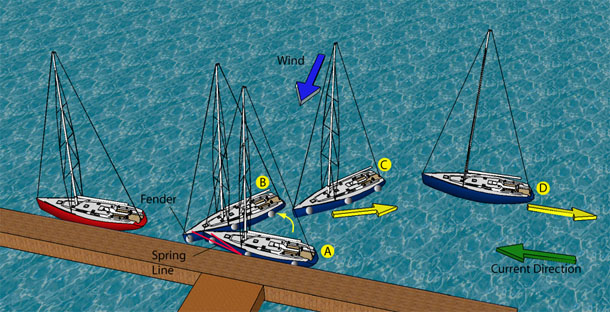
This is a little more tricky. If you try to go out forward the wind could potentially push you into other boats. Additionally, as you turn the wheel to head out, the rear of the boat will swing around towards the dock and other boats. therefore it is recommended that you reverse out using a spring line.
(A) Once you are confident in your plan,
- Appoint a crew member to use a fender at the front of the boat to prevent the boat from touching the dock.
- Release and stow the dock lines but leave one spring line from the dock near the center of the boat attached to the front of the boat.
- The spring line should be arranged so that it is attached to the forward cleat, runs freely around the dock cleat, and returns back to the appointed crew member. In this manner, the crew member can release the line and retrieve it by letting it slip around the dock cleat. ENSURE that there are no knots in the line to get caught on the dock cleat as it runs through.
- Turn the wheel towards the dock and engage the forward gear.
- This will have the effect of pushing the rear of the boat away from the dock.
(B) Once the boat has turned out from the dock, engage reverse and have your forward crew member release and retrieve the spring line.
(C) Continue backing out to be completely clear before engaging forward gear. Remember the rear of the boat will swing back towards the dock once you engage forward and turn the wheel to windward, so ensure there is plenty of room.
Module 7 Sailing - Excerpt:
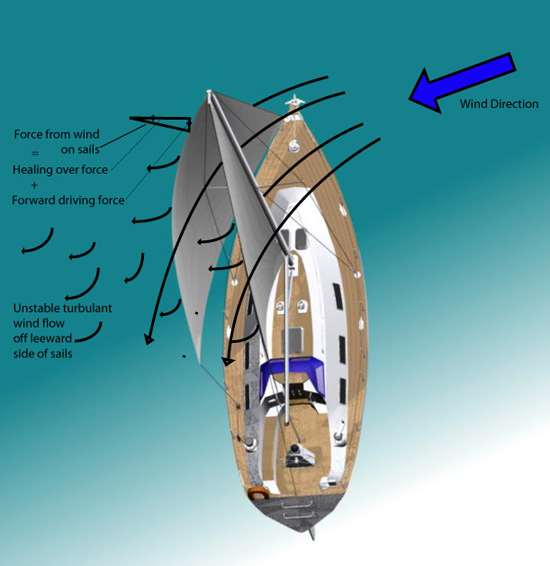
Conversely, when you ask the wind to bend too much, the wind will spawn off creating turbulent airflow. This reduces the effect of the sails and slows the boat. The higher the velocity of the wind the less the wind tends to bend. This is one of the reasons why in high wind conditions you need to reduce the size of the sail. Since the sail is smaller when reefed, the wind is required to bend less over the distance from the front (luff) of the sail to the back (leech) of the sail and therefore the wind will not break away from the sail as much. Once the wind breaks away from the low-pressure side, as shown in the diagram below, you're reducing efficiency. In the same way, an airplane will stall. When the flow of air breaks away from the top side of the wing, the lift is lost and the plane quickly aims itself at the ground. In sailing, the result is less dramatic. Simply let the sail out and the wind will reattach to the leeward side of the sail.
Module 9 Anchoring and Mooring- Excerpt:
Care must be given to swing. As the wind changes during the night, your boat will move with the wind and can put you into a precarious situation by being too close to the shore. Many times you'll find an anchorage area with moorings. Remember that boats tied to moorings swing less than anchored boats. In this circumstance, you may swing into other boats. The golden rule is "watch your swing".
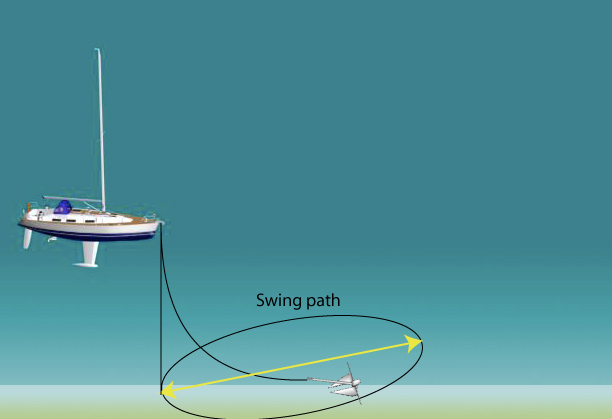
In addition, consideration must be given to the tide. As the tide "ebbs" out, you not only get closer to the bottom but your swing circle grows and the shore becomes closer. This diagram shows your swing path with deep water and the correct scope.
Module 10 Emergencies - Excerpt
Deep Beam Reach
- Bear away to a broad reach
- Trim the main sail for speed, furl, or drop jib.
- Tack
- Sail a beam reach toward the victim.
- Make the final approach to the leeward of the victim.
THE TESTS
Each Module has associated with it approximately 20 test questions. Here is an example?
Q Who has the Ultimate right of way in this scenario?
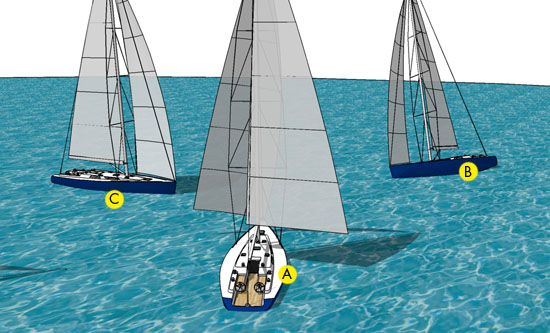
You will find the answer to this question in Module 5 of the Skipper Course.
Upon passing all the tests associated with each module, your NauticEd Sailing Certificate is automatically updated. This is not a USCG Captain's license. It is an acknowledgement that you have passed the NauticEd Skipper Course which is recognized by charter companies worldwide.
Other Courses you may consider are:
Free Basic Sail Trim Sailing Course
Qualified Crew Sailing Course
Get your sailing certification started now with the NauticEd Skipper Sailing Course.
Trusted by the world's leading sailing companies
From our students
4.9 out of 5 average across 75,291 student course ratings.
-
"I liked that there wasn’t pressure to rush. I could actually understand what I knew and what I still needed to work on."
Jamie, first-time boater
-
"By the time we chartered, I felt prepared instead of just approved. That made all the difference."
Alex, preparing for bareboat charter
-
"NauticEd helped me see boating as a skill I could build, not something I had to pass or fail."
Morgan, new boat owner