



















- Home
- About Us
- Sailing Courses
- Powerboat Courses
- SLC - International License
- Yacht Vacations
- Find an On-Water Instructor
- Practical Courses
- Fighting Childhood Cancer
- Free Courses Signup
- Student Benefits
- Gift a Sailing Course
- Sailing Opportunities
- Sailing Licenses and Certifications
- About the Sailing Certifications
- Sailing Blog & Helpful Articles
- NauticEd Podcast Series
- Yacht Charter Resources
- School Signup
- Instructor Signup
- Affiliate Signup
- Boat Sharing Software
- Sailing Industry Services
- Support & Contact
- Newsroom
- Privacy Policy

Maneuvering Under Power and Docking | Online Course



Master Sailboat Docking with Control
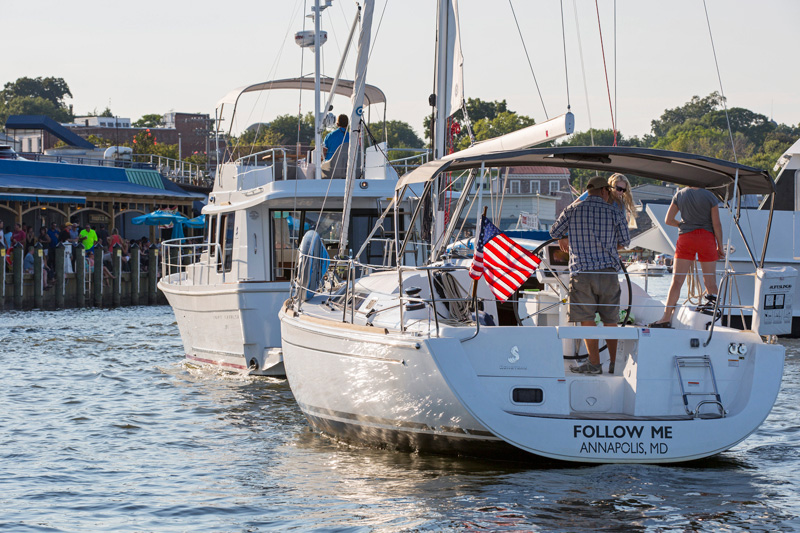
Docking isn’t guesswork — it’s a skill you can master. Whether you’re bringing a 40-foot monohull into a tight slip, handling a catamaran in crosswinds, or performing a Mediterranean mooring, this course gives you the structured techniques to maneuver under power with confidence.
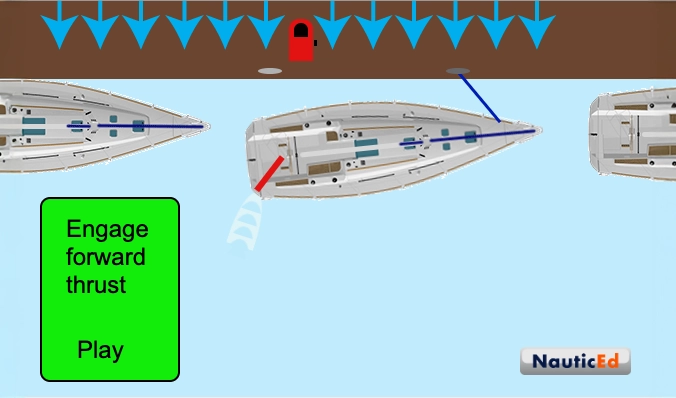
Created by NauticEd’s world-class instructors, including founder Grant Headifen, the course blends proven methods with clear step-by-step animations so you’ll understand not just what to do, but why it works.
✓ Learn professional docking techniques for monohulls (single & dual rudder) and catamarans
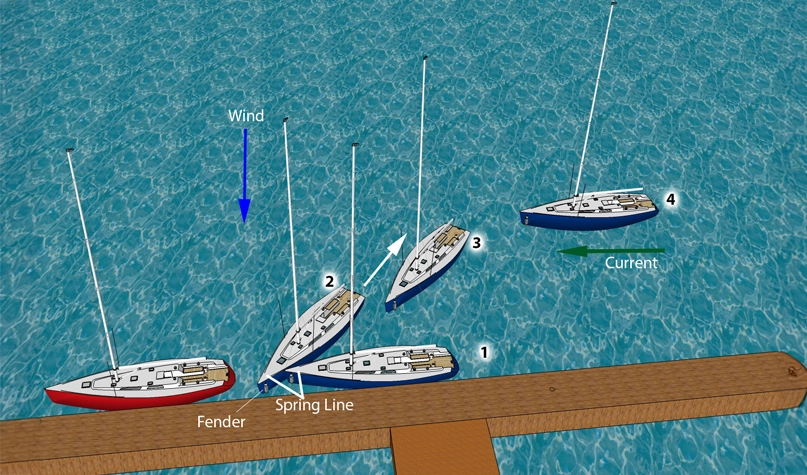
✓ Handle slips, end ties, crosswinds, and Med mooring with confidence—master spring lines, prop walk, and advanced boat-control maneuvers
✓ Includes 27 structured on-water exercises + optional VR practice
✓ Recognition on your free NauticEd resume upon completion
✓ Lifetime access, including free updates online or in the NauticEd App
✓ 30-day Money Back Guarantee
Estimated time: 4 hours
Price: $39 (or $33 with the Skipper Large Keelboat Bundle)
Bonus: All NauticEd sailing students receive the free Basic Sail Trim and Nav Rules courses, free eLogbook and Boating Resume, and special discounts from our industry partners. What's included >
What Students Say
✨AI generated from student reviewsSailors consistently call Maneuvering Under Power & Docking one of the most valuable and eye-opening courses they’ve ever taken. Students highlight the clarity of explanations, the state-of-the-art graphics and animations, and the depth of real-world scenarios — from docking in strong winds and currents to mastering spring lines, prop walk, and Mediterranean mooring. Many note that even with years of sailing or professional certifications, they learned new techniques and gained a deeper understanding of how boats actually behave under power. Beginners appreciate how the course makes complex topics approachable, while seasoned captains value the advanced insights on catamarans and dual-rudder monohulls. Across hundreds of reviews, the theme is the same: this course builds confidence, eliminates stress, and gives sailors the skills to dock smoothly every time.
Why Take Docking and Maneuvering Under Power?
Docking and maneuvering a sailboat under power is one of the most overlooked and under-taught NECESSARY skills. When sailing in open waters, it's reasonably difficult to hit something so long as you have a proper lookout, radar, and navigation skills. When maneuvering around in the marina, it's reasonably easy and common to hit something—namely the dock or other boats. And of course, hitting something is expensive and embarrassing.
You will receive access to our interactive online sailing course and the real-time graded tests. This $39 course will take you about 4 hours to complete online, including the test. The practical exercises will take about 2 hours to complete on the water or in Virtual Reality. This course will give you one of the best returns on investment you have ever made. $39 here now can save you thousands of $$$ in damage. Looking good in the Marina? - PRICELESS.
This Course is perfect for you if:
- You want the confidence to dock a sailboat in a slip, even when crosswinds make it difficult.
- You’ve struggled with docking before and are ready to leave behind the dents, repair bills, and “bumper-car” landings.
- You often find yourself sailing single-handed or with a limited crew, and you’d like repeatable docking techniques that reduce stress.
- You’re getting ready for a catamaran charter and need a hands-on understanding of twin-engine maneuvering and tight docking situations.
Your enrollment includes lifetime course access, free updates, and NauticEd’s complete satisfaction guarantee.
What You'll Learn in the Maneuvering Under Power & Docking Course
Register for the Maneuvering Under Power & Docking Online Course and learn how to dock a sailboat like a pro. This course helps you develop the skills and assurance to bring your boat into slips, manage crosswinds, and work confidently in tight marina spaces — whether you’re at the helm of a monohull or a catamaran.
For those preparing to charter, looking after their own sailboat, or simply hoping to take the stress out of docking, it offers practical techniques that make maneuvering under power smooth and reliable. From mastering prop walk and spring lines to advanced skills like Mediterranean mooring (Med mooring), you’ll gain the strategies needed to dock with total control.
Includes 27 practical on-water exercises plus optional Virtual Reality training with MarineVerse to help you build muscle memory before you ever reach the dock.
View the Course Topics
Momentum & Control
- Understanding sailboat gear and throttle controls
- How momentum affects docking and close-quarters maneuvering
- On-water momentum exercises to build control
- Forward handling in tight spaces
- Reversing into slips with precision
- Anchoring under power
- Experiencing prop walk and how it works
- Factors that influence prop walk (P-Factor, wash-lift effect)
- Using prop walk to your advantage and recovering when it “bests” you
- Moving the aft and bow with precision
- Effective use of bow thrusters
- Force alignment and moment balance
- Using rudder force with spring lines
- Springing on and springing in
- Spring line exercises & designing maneuvers
- Leaving the dock: end ties and slips
- Returning to the dock: slips, ferrying, and end ties
- Advanced Mediterranean mooring: standard, with anchor, and long-line ashore
- Catamaran maneuvering: twin engines, rudder control, “cat play,” and advanced techniques
- Dual-rudder monohull handling: unique challenges and docking maneuvers
Everything You Get with This Course
- Learn how to dock and maneuver sailboats like a pro! This online course gives you the theory, practical advice, and strategies to dock in any condition.
- Duration: Approximately 4 hours, self-paced—learn at your own speed. Contains 27 practical exercises in a PDF download to complete on the water.
- Unlimited Access: Lifetime access lets you review course materials anytime. Course updates are free.
- Free Stuff: All NauticEd sailing students receive 2 free courses (Basic Sail Trim and Nav Rules), a free eLogbook and Boating Resume, and special discounts from our industry partners.
- Recognition: Upon successful completion, you receive immediate recognition on your sailing resume that verifies for charter and insurance companies that you've completed the course.
- Qualification & Endorsement: This course leads to additional qualification and endorsement for the Skipper bundle of courses and Skipper Large Keelboat certification.
- Convenient Formats: Take the course on your desktop or laptop—and tablet or mobile phone using the free NauticEd App.
- Or buy this Maneuvering Under Power course as a hardcopy paper book from our Amazon Store. Videos, animations, and links are included in the book using QR codes.
- View an excerpt of the Maneuvering a Sailboat under Power Sailing
Price Today: $39 (or $33 with the Skipper Large Keelboat Bundle of sailing courses)
Next Steps after Your Online Course
- Practice, practice, practice... The course provides many practical exercises that you can practice on the water. Or, connect with an Instructor Near You and continue your training on the water with a certified NauticEd instructor.
- Practice in Virtual Reality. VR offers many advantages, similar to pilots practicing on simulators. More practice for better retention and "muscle memory", no cost of mistakes (i.e., you can push training further than in the real world), and it's also just fun!
- Level up your training. After the Docking course, take Skipper, then Bareboat Charter Master, and add electives—nav, weather, safety—so you’re comfortable in more conditions.
Foreword by the Author, Grant Headifen
Near the beginning of my open water sailing career, I chartered a 46-foot sailboat in St Maarten. In St Maarten, the charter base is located in a protected cove but with a tricky reef entrance...
Read the Foreward
...Therefore, the charter base requires that a pilot come out to your boat in a speedboat, jump on board, bring the boat through the reef, and park it in the slip at the marina for you. I spent some time observing this very talented Rastafarian expertly maneuver my chartered boat into the slip. It was a maneuvering job with which I was very impressed. Why? Well, just days before I had knocked the BBQ off the back of the 46 ft sailboat because I could not maneuver the boat in a tight marina with 20 knots of side wind just as it was getting dark. I was trying to back up to a concrete wall and simultaneously lasso pilings as they went past to hold the front of the boat in place and not hit the wall. As captain, I was seeing very quickly that my open water experience was not paying off and was about to cost me, the charter company, and the insurance company a lot of money.
I remember a year later maneuvering a Beneteau 50 ft sailboat into the marina in the beautiful port of Bonifacio, Corsica. Our slip was right next to the sidewalk restaurant loaded with tourists, so it was imperative to my ego to get it right. Well, I did but actually, I still think it was really more luck than anything else. As we sat on the back of the boat celebrating a no-damage docking, we watched a crew expertly maneuver their boat backward down a row of slips, turn right angles then back their boat into a tight slip, stopping perfectly. We all cheered and clapped as it was very impressive. I vowed right then and there to learn the skill.
One year later, I was smiling as I maneuvered a 50-foot sailboat in a very tight harbor in Kos, Greece. You can always tell how you are doing in a busy port. If you're doing well, everyone on the other boats will be watching and will continue to drink their Gin. If you're doing badly, they are all putting down their drinks and putting fenders over the side. In Greece, everyone relaxed with their Gin!
When I created the fractional ownership industry for sailors a few years later, it was obvious that a course like this needed to be developed. As a result, several thousand students have taken this course. Through 27 practical exercises, this Maneuvering Under Power course will teach you how to practice and master the skill of placing the boat wherever you want, every time in all wind conditions, with confidence. The lesson is arranged so that you can first read the material and begin to understand the theory. Each chapter also has associated practical exercises that you absolutely must perform and repeat to become an expert. The exercises are designed to get you extremely comfortable with maneuvering your boat.
Upon completion, you'll see the NauticEd Maneuvering Under Power and Docking Online Course added to your NauticEd Sailing Resume. I'm also confident that you'll be so comfortable with maneuvering and backing your boat in a tight marina that you'll never have onlookers put down their drinks and pick up a fender. You'll feel great, and even if you mess it up a bit, you'll know exactly how to do it better next time. If you're hesitant about the mere $39 cost of this course, just think of the cost and embarrassment of one - just one ding into another boat. When you take this course, we guarantee you'll have less intimidation when maneuvering your boat and you'll significantly reduce damage to your and other people's boats.
No one ever has, but if you don't think you received $39 worth of potential damage-saving value, simply contact us and we'll happily refund your investment.
In the conclusion chapter, we show you how you can access all the exercises on your mobile device and take them with you to the boat. It leads you through all the exercises you should perform on the water to learn how to maneuver and dock your sailboat under power.
Finally, I can not stress enough how important it is to engage in the optional Virtual Reality module. As with any practical skill, practicing your skills over and over is the only way to become competent. Instructions for VR are inside the course.
Please enjoy our Maneuvering a Sailboat Under Power Course (and no damage docking) brought to you by Captain Grant Headifen.
About NauticEd
NauticEd is the leading provider of modern sailing education, combining online sailing courses with accredited on-water instruction. With over 300,000 students worldwide, NauticEd is the only U.S. sailing body recognized for meeting U.S. Coast Guard and NASBLA standards under the American National Standards for boating education.
Our online courses pair with on-water training, and your free eLogbook and sailing resume track each milestone. Whether you’re starting out or working toward higher endorsements, NauticEd gives you a clear, standards-aligned way to grow real skills.
Register for the NauticEd Docking and Maneuvering a Sailboat Under Power Course now! It's Fun!
By Grant Headifen
NauticEd Global Director of Education
View Maneuvering Under Power Course excerpt
Student Reviews
Daniel S.
2026, 01 Jun. 22:36
Very thorough
Keith A.
2026, 01 Jun. 10:12
Really enjoyed this one. It helped me with the theory of getting in and out of my new slip.
Ian A.
2026, 20 May. 02:46
Complete essentials with additional interesting information.
Scott N.
2026, 19 May. 20:31
I have always been hesitant to charter a large catamaran. This course is a great education in the nuances of the differences of a dual hull craft and largely dispels the concern, while also making it clear you would want to practice for a few hours with an expert, and without a large audience.
Gary F.
2026, 14 May. 05:14
all the manuvering exercises and videos
Kevin C.
2026, 12 May. 21:22
This is challenging material to conceptualize and the text along with the videos are very helpful.
David L.
2026, 02 May. 20:16
Very informative.
Robert C.
2026, 01 May. 16:41
knowledge that I needed for consistant sailboat maneuvering/docking under power
Joseph L.
2026, 25 Apr. 20:44
Overall, it’s a great self-pace course! From the reading material to the videos are icing on the cake to ensure the visual aspect of learning. I will definitely recommend NauticEd to others as the TOP Sailing Education Platform for learning how to sail with confidence.
Jim M.
2026, 25 Apr. 19:26
The VIDEOS are the best way to explain the process.
Scott B.
2026, 17 Apr. 01:17
Wow! Great information. Eye opening. Just what I was hoping to learn. Now I need to launch the boat and practice.
Curtis C.
2026, 13 Apr. 18:09
Detailed evaluation questions
List Price: $39.00
Excerpt from the course
Expand Excerpt from the courseReversing a boat has become quite a favorite of mine now and fun to teach. Please don't just give these exercisers lip service. Actually, get out and do the exercises and - who cares if others are watching - you'll be able to out back and outmaneuver them anytime after this. It's a practiced skill that you'll be glad you did next time you're in a tight marina in some exotic place with 20 knots of wind on the side and everyone is watching you. The question is - will they be nervous or impressed - it's up to you.
This exercise should take about 45 minutes and is really fun to do. Please actually do it rather than just read it. You'll learn so much and be incredibly confident afterward. It's more effective to do this on a windy day. Pick a buoy or ideally two that are about 5 boat lengths apart that are out away from the marina and, of course, during the exercises keep a good watch out for traffic.
| Exercise 9: With the boat stopped and pointing downwind, first put the wheel hard over and then rev the engine in reverse to 2300 rpm for about 2 seconds. |
| What you learned: The boat is not nearly as responsive as the same exercise in forward. In fact, it is doubtful that anything actually happened. Except for a bit of prop walk. |
| Note: The rudder only responds to act on the boat when water is flowing over it. When in reverse, the propeller does not help to push water over the rudder, and thus control of the boat is only achieved by reverse motion of the boat. |
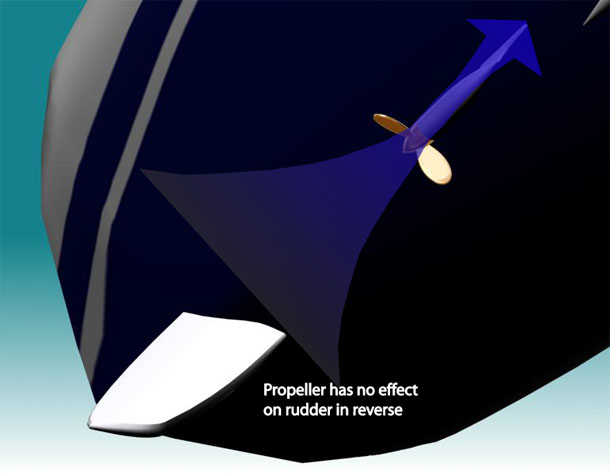
| Note: Whenever the boat is reversing, DO NOT take your hands off the wheel or allow it to spin. The fulcrum of the rudder is at the front. Water moving over the rudder will cause the rudder to slam sideways and potentially break the wheel controls. ALWAYS keep a hand tightly held on the wheel. This effect is like trying to hold a sheet of plywood on the downwind edge against the wind without it flipping around on you - almost impossible. When it flips - it's going to hurt. Same as the wheel, when the back-flowing water pushes against the rudder it can whip the rudder over - spin the wheel very fast and slam the workings for the wheel to rudder connections very hard and very likely cause damage. Backing in a marina with high winds is the last place you want the rudder connection to come off. Scared? Don't be, just don't let go of the wheel when backing. |
| Note: Whenever in reverse, only put the wheel a maximum of 80% of the way hard over. If it is all the way over the rubber acts more like a vertical bulldozer blade and reduces the turning effectiveness. |
| Note: When shifting from forward into reverse and vice versa, ALWAYS stop in neutral for 1-2 seconds before shifting gears. Drifting in a marina under high winds and a sheared propeller shaft key is not something you want to experience. Scared? Don't be, just don't shift the gear lever fast. |
| Exercise 10: With the boat pointed at about 30 degrees off the wind and idling forward at about 1000 rpm, put the engine into reverse while attempting to hold the boat straight and then begin to back up. |
| What you learned: On a windy day this is nearly impossible. The wind will take over and push the bow downwind as soon as the boat stops and thus water stops flowing over the rudder. Regaining control and trying to get the boat to begin backing up while staying on course is difficult and will use up a lot of space. Space that is at a premium in a marina. So instead, always start your backing with the wind to your stern even if that has you initially pointing in the wrong direction. |
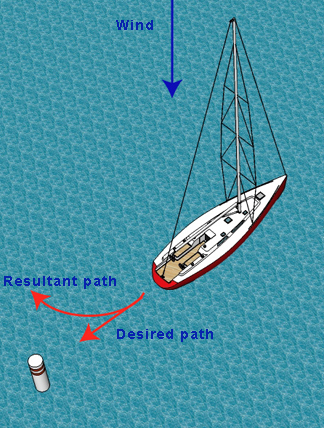
Even if you try it the other way to counteract the prop walk - in high enough winds your bow will still be blown downwind.
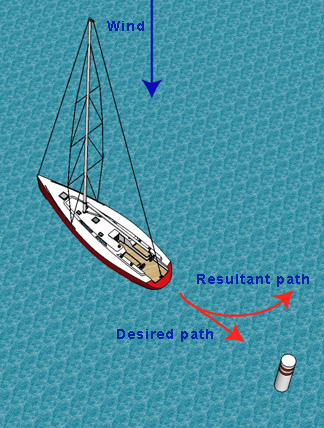
| Exercise 11: With the boat stopped and positioned stern to wind - just hang out for a second and observe the boat behavior. Then move into forward gear at about 1000 rpm and slowly move forward, now put the engine in reverse at 2000 rpm. Watch the boat come to a stop and begin backing up. |
| What you learned: You'll first notice that sitting there with your stern to the wind is a stable position for the boat to be in. IE the wind really does nothing to the boat and you can hang out like this for a while. Especially in a marina when you are waiting for other boats to clear out or deciding which slip to go into. Besides a bit of prop walk, once you start going backward, the boat will hold course and will back straight without all the space used up in the exercise above. Therefore, whenever possible, always begin backing with the stern of the boat facing upwind. Let's repeat that and put it in bold - whenever possible, always begin backing with the stern of the boat facing upwind. |
| Note: There will be some effect from prop walk which will turn the stern of the boat to port. So learn to anticipate prop walk. IE you know the boat is going to pull stern to port so angle your boat as such before you start to reverse. |
| Note: Simple rule of thumb for steering a boat backward. If you want the back of the boat to go one way then turn the wheel that way. Actually, this is the same for going forward, if you want the front of a boat to go right then turn to the right. This is why you see some people turn around and get in front of the wheel when going backward because it is the same as going forward. As you get used to backing like this and especially practicing doing figure 8’s around buoys, you’ll no longer need to step around the wheel. |
Other Sailing Courses that you might enjoy:
Qualified Crew Member Sailing Course
Coastal Navigation Sailing Course
Trusted by the world's leading sailing companies
From our students
4.9 out of 5 average across 74,233 student course ratings.
-
"I liked that there wasn’t pressure to rush. I could actually understand what I knew and what I still needed to work on."
Jamie, first-time boater
-
"By the time we chartered, I felt prepared instead of just approved. That made all the difference."
Alex, preparing for bareboat charter
-
"NauticEd helped me see boating as a skill I could build, not something I had to pass or fail."
Morgan, new boat owner