
Sailing & Powerboating Certification
Whether you want to learn the basics, skipper your own boat, handle a larger yacht, take family or friends on a bareboat charter, or prepare for longer offshore passages, NauticEd helps you build toward the certification that matches the responsibility you want to take on.
NauticEd certifications combine required boating education with documented on-water experience and, where applicable, instructor-led practical training and assessment. And because there are no required certification prerequisites, you can begin working toward the certification that makes sense for your goals.
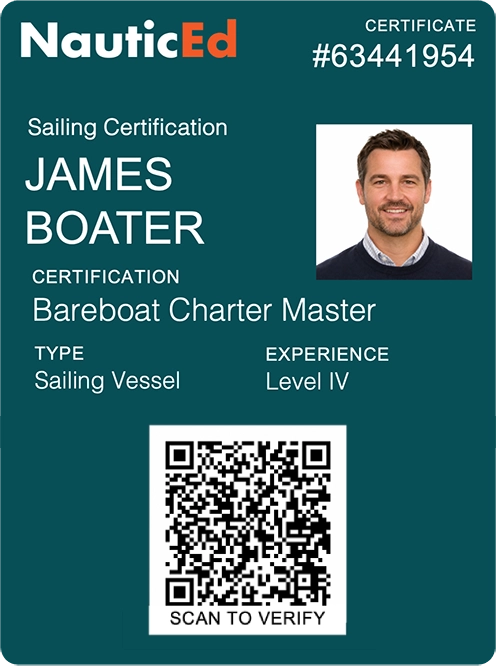
Sailing Certifications
Choose the certification that matches your sailing goals and the level of responsibility you want to take on. Whether you want to learn the basics, skipper your own boat, handle a larger yacht, take family or friends on a bareboat charter, or prepare for longer offshore passages, you can start working toward the certification that fits your goals - there is no required certification sequence.
-
Qualified Crew
Learn the Basics and Sail as Crew
For new or occasional sailors who want to understand sailing fundamentals, gain onwater experience, and become a capable crew member.
QUALIFIED CREW -
Basic Sailing & Skippering
Learn to Sail and Build Basic Skippering Skills
For new sailors who want hands-on instruction to build practical sailing, boat-handling, and fundamental skippering skills with a NauticEd instructor.
BASIC SAILING & Skippering -
Skipper Small Keelboat
Skipper Sailboats Typically up to 25 ft (7.6m)
For sailors preparing for smaller keelboats for local and day sailing.
SKIPPER SMALL KEELBOAT -
Skipper Large Keelboat
Skipper Sailboats 26 ft (7.9m) & Larger
For sailors stepping up to larger keelboats and taking greater responsibility for boat handling, crew, and day sailing.
SKIPPER LARGE KEELBOAT -
Bareboat Charter Master
Multi-day Sailing & Bareboat Chartering
For sailors preparing to take responsibility for larger cruising sailboats on multi-day trips, island-hopping routes, and bareboat charters.
BAREBOAT CHARTER MASTER -
Captain Offshore Sailing
Offshore Passagemaking
For experienced sailors building the knowledge and experience for longer passages and offshore sailing.
CAPTAIN OFFSHORE
Powerboating Certifications
Choose the certification that matches your powerboating goals and the level of responsibility you want to take on. Whether you want to skipper a smaller powerboat, step up to a larger vessel, or prepare for multi-day trips and bareboat chartering, you can begin working toward the certification that fits your goals — there is no required certification sequence.
-
Skipper Small Powerboats
Powerboats up to 25 ft (7.6m)
For boaters preparing to skipper smaller powerboats for local and day boating.
SKIPPER SMALL POWERBOAT -
Skipper Large Powerboats
Larger Powerboats — Local & Near-Coastal
For boaters stepping up to larger powerboats and taking greater responsibility for boat handling, onboard systems, and crew during local and near-coastal outings.
SKIPPER LARGE POWERBOAT -
Bareboat Charter Master for Powerboats
Multi-day Powerboating & Bareboat Chartering
For boaters preparing to take responsibility for larger powerboats on multi-day trips, island hopping, and bareboat charters.
BAREBOAT CHARTER MASTER
What Your NauticEd Certification Represents
More than course completion.
-
Education
Complete the required online education for your certification, building the knowledge, theory, and decision-making needed for the boat and level of responsibility involved.
-
Experience
Record qualifying time on the water in your NauticEd Logbook. Experience you already have can count when it meets the applicable requirements.
-
On-Water Skills
Build the practical skills expected for the boat and responsibility involved. Instructor training can help develop skills, and successful formal assessment, where applicable, can independently verify practical competence.
Built on U.S. Coast Guard Recognized Standards
Independent verification. Nationally recognized standards.
Independent standards matter. Anyone can create their own standard. NauticEd's certifying program comforms with the U.S. Coast Guard’s American National Standards.
That gives you confidence that NauticEd’s certifications are grounded in a recognized national standard - and gives others a credible basis for trusting what your certification represents.

Example: Skipper Small Keelboat
How NauticEd Certification Works
You don't have to start over. NauticEd recognizes relevant boating experience you already have while giving you a clear path to complete the education, experience, and on-water development for the certification you're working toward.
-
1
Complete the Required Online Education
Complete the online education required for the sailing or powerboating certification you are pursuing. The coursework builds the boating knowledge, theory, and decision-making needed for the type of boat and level of responsibility involved.
You can start with the certification that fits your goals; each certification bundle includes the required knowledge coursework for that certification.
-
2
Document Your Boating Experience
Record your qualifying on-water experience in your FREE NauticEd Logbook. Experience you already have can count if it meets the requirements.
Your Logbook tracks the boats you've operated, your role onboard, and the experience relevant to each certification, so you can see what already qualifies and what experience you may still need to gain.
-
3
Build Your On-Water Skills
Start by reviewing the skills expected for your certification and where you currently stand. Identify what you already do well and where you may have gaps in your on-water skills that require more training or practice.
If you're new to boating, unsure of your skills, or haven't been on the water in a while, a NauticEd instructor can help identify skill gaps and recommend training or practice. A successful formal on-water assessment, where applicable, can independently verify your practical competence.
Assessment, training, and practice can be combined in different ways depending on what you need. The competence expected for the certification remains the same.
-
4
Meet the Requirements. Receive Your Certification
NauticEd automatically tracks your completed education, qualifying experience, and applicable instructor sign-offs. Once you meet the certification requirements, your certification is awarded, and your FREE Boating Resume updates to reflect it.
Your certification is also available as a digital wallet credential, giving you a current, portable record of your certification and assessment status.
Your Free Logbook & Boating Resume
Your boating history and credentials, organized and ready to share.
Your free NauticEd Logbook records your on-the-water experience, including the boats you’ve operated, your role onboard, and the experience that counts toward certification requirements
Your Boating Resume brings that record together with your completed education, certifications, and, when applicable, instructorassessed practical competence. It gives you a continuously updated summary of your boating background that you can share with charter companies, insurers, instructors, and other boating professionals.
That depth of documented information is a major reason NauticEd credentials are trusted by charter companies: they can see the education and experience behind the certification, plus any instructor-verified practical competence — not just the certificate itself.
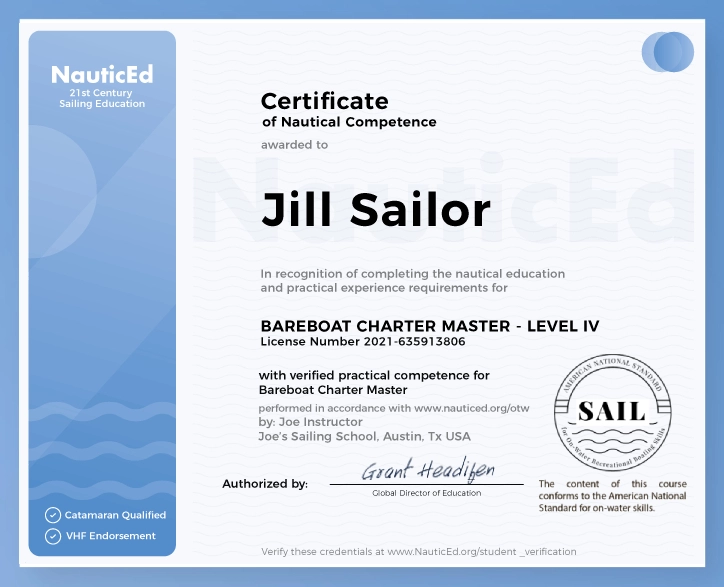
Need an International License?
A NauticEd certification and an international boating license are different credentials. In many Mediterranean charter destinations, an accepted international boating license or credential is required. Requirements vary by country and charter operator.
NauticEd offers:

-
SLC
International Sailing License and Credentials
For qualified sailing skippers.
-
SLC-p
International Powerboating License and Credentials
For qualified powerboat skippers.
-
SLC-p-day
International Powerboating License and Credentials
For qualified day-use powerboat skippers up to 30 ft (9m) and 300hp.
-
SLC-jetski
International Powerboating License and Credentials
For operating Jet Skis abroad where an accepted personal watercraft license is required.
Certification ≠ license. International licensing may matter depending
on where you boat or charter. Here is where to go if that is what you need.
Frequently Asked Questions
Which sailing or powerboating certification should I start with?
Start with the certification that matches what you want to do on the water and the responsibility you want to take on.
For sailing, NauticEd offers certifications ranging from Qualified Crew and introductory sailing skills to skippering small or large keelboats, managing multi-day cruises and bareboat charters, and preparing for offshore passages.
For powerboating, NauticEd offers certifications for operating smaller recreational powerboats, taking responsibility for larger powerboats, and managing multi-day cruising and bareboat charters.
Whether you're a complete beginner, an experienced crew member, a boat owner, or someone preparing to charter a yacht, choose the certification that fits your goals.
You don't have to start at the beginning and work through every certification.
Explore the sailing and powerboating certifications above to find the right fit.
Do I have to earn NauticEd certifications in order?
No. NauticEd does not require everyone to follow a fixed sequence of certifications.
You can begin working toward the certification that matches your boating goals, even if you haven't earned the certifications that appear before it.
For example, an experienced sailor preparing to skipper a larger cruising sailboat doesn't need to earn a small-keelboat certification first.
Each certification has its own education, experience, and applicable practical requirements. Relevant experience you already have can count.
NauticEd recognizes what you've already learned and experienced, allowing you to focus on developing the additional qualifications you need.
How do sailing certification levels work at NauticEd?
Sailing certifications are often described as levels, progressing from introductory sailing through skippering, cruising, and offshore sailing.
NauticEd approaches certification differently. Its certifications recognize different types of boating responsibility, and there is no mandatory sequence.
NauticEd also uses a Rank and Level system to recognize qualifications and experience.
Your Rank identifies the certification you've earned, such as Skipper Large Keelboat or Bareboat Charter Master. Your Level reflects the amount of qualifying boating experience you've documented for that Rank.
Two sailors can therefore hold the same certification while having different amounts of qualifying experience.
Your qualifications can continue developing as you gain experience, rather than stopping when you complete a course.
Is passing an online sailing or powerboating course the same as earning certification?
No. Completing an online course demonstrates that you've learned and passed the required knowledge material, but certification involves more than course completion.
NauticEd's competence-based certification system brings together three important elements: knowledge, on-water skills, and real boating experience.
You complete the required education, document qualifying boating experience, and develop the practical skills appropriate to your certification. Instructor training and assessment requirements vary by certification.
Where applicable, a successful formal assessment by a NauticEd instructor provides independent verification of practical competence.
A course develops and tests your knowledge. Certification recognizes that you've met the defined requirements for a boating qualification.
I already have sailing or powerboating experience. Do I have to start over?
No. NauticEd recognizes relevant boating experience you've already gained, even if it was before you joined NauticEd.
Enter your previous experience into your free NauticEd Logbook, including the boats you've operated, their size and type, and your role aboard.
Experience that meets the applicable certification requirements can count toward your qualification.
You can also begin the required online education while continuing to gain experience.
The goal is to recognize legitimate existing experience, not make experienced boaters repeat boating days unnecessarily.
What counts as a qualifying boating day?
A qualifying boating day is a day of actual on-water experience that meets the requirements for the certification you're pursuing.
Generally, a qualifying day requires at least four hours on the water. Spending eight hours on the water during the same calendar day still counts as one day.
The type and size of boat, whether you were skipper or crew, and the particular certification can affect whether a day qualifies.
Your NauticEd Logbook records your overall boating experience and helps identify the days that qualify toward your certification.
Not every logged day necessarily qualifies for every certification, but it still contributes to your overall boating history.
Why does NauticEd require real boating experience for certification?
Boating competence takes more than knowing the theory. It develops through learning, practice, and real experience applying knowledge on the water.
Conditions are never exactly the same. Docking in calm weather is different from docking in wind or current. Changing weather, waves, traffic, and unfamiliar situations all affect how a boat behaves and the decisions its skipper must make.
Read more
Do I need on-water training or an instructor assessment to earn NauticEd certification?
That depends on the certification, your existing experience, and the practical skills you need to develop.
NauticEd recognizes that boaters arrive with different backgrounds. Some are just getting started, while others already have years of experience operating boats.
On-water training helps you develop practical skills, build experience, and address areas where you need additional instruction.
Formal on-water assessment evaluates whether you can demonstrate the defined practical competence for a particular certification. Successful assessment can add independent verification of those skills to your NauticEd credentials.
Training and assessment requirements vary by certification. For many experienced boaters, training can focus on specific areas rather than repeating skills they already possess.
If you're new to boating, unsure of your skills, or haven't been on the water in a while, a NauticEd instructor can help identify skill gaps and recommend training or practice.
What do “Instructor Assessed” and “Not Assessed” mean on a NauticEd certification?
These terms distinguish documented certification qualifications from formal instructor assessment of practical competence.
Instructor Assessed indicates that the certificate holder has successfully completed the applicable formal on-water practical assessment with a NauticEd instructor or assessor.
Not Assessed means that formal practical assessment has not been completed for that certification. It does not mean the boater failed an assessment or lacks practical skills.
NauticEd recognizes required education and qualifying experience separately from instructor-verified practical competence.
This distinction helps charter companies, instructors, and others understand what the certification documents and what has been independently assessed.
Why does NauticEd use interactive online education rather than relying only on textbooks and videos?
Boating books and instructional videos are valuable learning resources. But many boating concepts are easier to understand when you can see how they work, interact with them, and test your understanding.
Educational research* supports the effectiveness of well-designed multimedia learning. Studies have found that animations can improve understanding compared with static illustrations, instructional videos can enhance learning, and repeated knowledge testing can improve long-term retention.
These methods are particularly relevant to sailing and powerboating, where students need to understand movement, changing conditions, and practical decision-making.
Read more
Online learning research references: Berney & Bétrancourt (2016), Does Animation Enhance Learning? A Meta-Analysis, Computers & Education; Noetel et al. (2021), Video Improves Learning in Higher Education: A Systematic Review, Review of Educational Research; Roediger & Karpicke (2006), Test-Enhanced Learning: Taking Memory Tests Improves Long-Term Retention, Psychological Science.
How does NauticEd's online testing help me learn and retain boating knowledge?
NauticEd uses testing as part of the learning process, not merely as a final pass-or-fail event.
As you progress through a course, testing helps identify subjects you understand and areas needing more attention. If you don't demonstrate the required knowledge, you can return to the material, review the concepts, and retake the tests.
The approach is:
LEARN → TEST → IDENTIFY GAPS → REVIEW → RETEST → DEMONSTRATE KNOWLEDGE → APPLY ON THE WATER
Read more
Research references: Yang et al. (2021), Testing (Quizzing) Boosts Classroom Learning: A Systematic and Meta-Analytic Review, Psychological Bulletin; Roediger & Karpicke (2006), Test-Enhanced Learning: Taking Memory Tests Improves Long-Term Retention, Psychological Science; Bates et al. (2025), The Learning Benefits of Mastery Quizzing Versus Other Quizzing Methods, Psychology Learning & Teaching; Butler & Roediger (2008), Feedback Enhances the Positive Effects and Reduces the Negative Effects of Multiple-Choice Testing, Memory & Cognition; Pan & Carpenter (2023), Prequestioning and Pretesting Effects: A Review of Empirical Research, Theoretical Perspectives, and Implications for Educational Practice, Educational Psychology Review.
What makes NauticEd's Learning Management System different from simply taking online boating courses?
Putting boating courses online isn't the same as creating a complete boating education and certification system.
Effective online education involves more than delivering lessons. Educational research* indicates that structured learning support, progress monitoring, feedback, and targeted learning interventions can improve educational outcomes.
That's why NauticEd developed its own integrated Learning Management System (LMS) specifically for sailing and powerboating education.
Rather than treating each course as an isolated learning experience, NauticEd brings together your education, boating experience, practical training, certifications, and ongoing progress in one system.
Read more
Learning Management System research references: Du, Liu & Zhao (2025), Empowering Students in Online Learning Environments Through a Self-Regulated Learning–Enhanced Learning Management System, Behavioral Sciences; Liu, Wang & Xu (2025), The Effectiveness of Learning Analytics-Based Interventions in Enhancing Students' Learning Effect: A Meta-Analysis of Empirical Studies, SAGE Open; Pan, Biegley, Taylor & Zheng (2024), A Systematic Review of Learning Analytics: Incorporated Instructional Interventions on Learning Management Systems, Journal of Learning Analytics.
What qualifications and quality standards do NauticEd instructors meet?
Being an experienced sailor or powerboater doesn't automatically make someone an effective instructor.
NauticEd instructors must meet defined experience, education, and teaching requirements, and their quality is monitored beyond initial approval.
Instructor quality isn't simply checked once. NauticEd combines qualification requirements, individual approval, established teaching standards, ongoing oversight, and transparent student feedback to support high-quality on-water instruction.
What is the NauticEd Logbook and Boating Resume, and why are they valuable?
Your NauticEd Logbook and Boating Resume provide an organized record of your boating education, experience, and qualifications.
The Logbook records your on-water experience, including the boats you've operated, your role aboard, and the experience that qualifies toward certification requirements.
The Boating Resume brings that history together with your completed education, certifications, and instructor-assessed practical competence when applicable.
Unlike a certificate that simply records completion of a course, your Boating Resume continues to reflect your developing qualifications.
You can share it with charter companies, instructors, marine insurers, and other boating professionals who want to understand your boating background.
It's a record of your boating experience and qualifications that grows with you.
Will a NauticEd sailing or powerboating certification qualify me to bareboat charter?
NauticEd's Bareboat Charter Master certifications are designed for sailors and powerboaters preparing to take responsibility for larger cruising boats on multi-day trips, including bareboat charters.
They combine required boating education with substantial documented qualifying experience. Formal on-water assessment, where applicable, can provide additional independent verification of practical competence.
However, certification alone does not guarantee approval to charter a particular yacht.
Charter companies consider relevant experience, the type and size of yacht, the destination, and the skipper's qualifications. Some may require additional practical verification or checkout procedures.
In destinations where an accepted boating license is required, an additional credential may also be necessary.
Your NauticEd certification and Boating Resume help charter companies evaluate your qualifications by providing information beyond course completion alone.
Is NauticEd certification the same as an international sailing or powerboating license?
No. Certification and international licensing serve different purposes.
A NauticEd certification recognizes that you've met the defined education, experience, and applicable practical requirements for a particular boating qualification.
An international boating license or credential may be needed to operate or charter recreational vessels in certain countries, particularly in Mediterranean charter destinations.
NauticEd offers the SLC family of international recreational boating licenses, including the SLC for sailing and SLC-p for powerboating.
Requirements vary by country, vessel, and charter operator. A NauticEd certification does not automatically replace an accepted international license where one is required.
For licensing requirements, international acceptance, and how to qualify, visit NauticEd's SLC International Boating License page.
How long does it take to earn a NauticEd sailing or powerboating certification?
It depends on the certification and how much qualifying boating experience you already have.
An experienced boater may already meet much of the required experience and can concentrate on completing the necessary online education.
A newer boater can begin the courses immediately while continuing to gain experience and develop practical skills on the water.
Instructor training and assessment requirements vary by certification, and some pathways recognize successful formal practical assessment separately.
There is no single course duration that determines when everyone earns a NauticEd certification.
Choose the certification that matches your goals, review its requirements, and use your NauticEd Logbook to understand what experience you already have and what you still need.