
QUALIFIED CREW CERTIFICATION - SAILING
The sails fill, the boat picks up speed, and the skipper calls for a tack. It's a lot more fun when you understand what's happening and know how to lend a hand. NauticEd's Qualified Crew Certification is for recreational sailors who want to become active, useful members of the crew, enjoy sailing with family and friends, and build meaningful experience on the water without taking skipper responsibility.
- Become a capable crew member: Understand sailing terminology, help with sails and lines, participate in common maneuvers, and contribute to safety aboard.
- Learn the sailing fundamentals: Complete NauticEd's Introduction to Sailing online course, covering how sailing works, basic sail handling, safety, and introductory navigation rules.
- Build real sailing experience: Document 10 qualifying sailing days on sailboats 20 ft (6.1 m) or longer. All 10 days may be logged as crew.
- Start with the experience you have: No prior NauticEd certification is required. Previous sailing experience can count when it meets the qualifying requirements.
U.S. COAST GUARD RECOGNIZED STANDARDS
The U.S. Coast Guard and NASBLA recognize NauticEd as meeting American National Standards.
Independent verification. Nationally recognized standards.
Independent standards matter. Anyone can create their own standard. The difference with NauticEd is that we meet an independent national standard rather than simply creating our own. Independent standards provide an outside benchmark for competence - adding credibility to your certification and confidence that the knowledge and skills behind it reflect recognized requirements for real-world boating.
WHAT THIS CERTIFICATION HELPS YOU DO
From leaving the dock to sailing across the bay and dropping anchor for a swim, there's plenty to enjoy and plenty to do as crew. Whether you're sailing with your spouse, family, or friends, becoming a knowledgeable and active crew member makes the experience more rewarding.
-

UNDERSTAND HOW SAILING WORKS
Learn the language of sailing and understand how the wind, sails, and boat work together. Recognize what's happening when the skipper calls for a tack, gybe, or change of course, and know how to respond.
-

TAKE AN ACTIVE PART IN SAILING
Help raise and trim sails, handle lines during maneuvers, and even take a turn at the helm under the skipper's direction. Experience the satisfaction of helping the boat sail rather than simply going along for the ride.
-

OPERATE SAFELY WITH PASSENGERS & CREW
Help prepare the boat, handle dock lines and fenders, assist with mooring or anchoring, and secure everything at the end of the day. Learn the everyday tasks that help make a sailing outing run smoothly.
-

CONTRIBUTE TO SAFETY ABOARD
Keep an eye out for other boats, obstacles, and changing conditions. Understand basic navigation rules, recognize common hazards, know how to use safety equipment, and speak up when something needs attention.
No prerequisite certification is required - the program includes the supporting education you need.
Start with Online Courses
QUALIFIED CREW CERTIFICATION REQUIREMENTS
Complete the required online sailing education, document your qualifying sailing experience, and receive your certification.
-
1
COMPLETE THE REQUIRED ONLINE EDUCATION
Complete NauticEd's Introduction to Sailing online course. It introduces sailing terminology, how wind and sails work together, basic boat handling, safety, and introductory navigation rules.
- Introduction to Sailing (required)
- Navigation Rules (recommended, optional*)
- Basic Sail Trim (recommended, optional*)
*Only Introduction to Sailing is required for Qualified Crew certification.
Start with Online Courses*Note: You receive credit for any courses you’ve already purchased.
Already know the material? Go straight to the test for topics you're familiar with and focus your time on new learning or where you need a refresher.
-
2
BUILD YOUR ON-WATER SKILLS
On-water competence matters. Develop your crew skills through real sailing experience, with NauticEd instructors available for additional training or, where applicable, independent verification of practical competence.
- Learning and sailing as crew? Whether you're new or experienced, you can earn Qualified Crew certification without instructor training or assessment by completing the Introduction to Sailing course and documenting 10 qualifying sailing days. All 10 days may be as crew. See Qualified Crew on-water skill expectations
- Build your crew skills. Learn to help with sails and lines, participate in tacking and gybing, steer under the skipper's direction, assist with departure and docking, maintain lookout, and contribute to safety aboard.
- Want to fill skill gaps or verify your skills? Work with an instructor to evaluate your skills, identify and address gaps, build relevant experience, or have your practical competence independently verified for your certification.
NauticEd instructors tailor training to your existing skills, experience, and goals, so you focus your time on the water developing the skills you actually need. More info
-
3
DOCUMENT YOUR SAILING EXPERIENCE
To earn Qualified Crew certification, normally document 10 qualifying sailing days in your free NauticEd Logbook.
Your sailing experience must meet these requirements:
- All qualifying days must be on sailboats 20 ft (6.1 m) or longer, including monohulls or sailing catamarans.
- Each qualifying day must include at least four hours on the water.
- All 10 days may be logged as crew. No skipper days are required.
Previous qualifying sailing experience counts when entered in your NauticEd Logbook. Powerboat experience does not count toward this sailing certification. You don’t need all 10 days to begin.
Optional Instructor-Assessed Pathway: A successful formal on-water assessment with a NauticEd instructor or assessor reduces the experience requirement from 10 to 4 qualifying sailing days. Instructor training or assessment is not required for the normal 10-day pathway.
You can begin the online course before you have all your sailing days and continue building experience as you sail.
-
4
MEET THE REQUIREMENTS. RECEIVE YOUR CERTIFICATION
NauticEd tracks your completed online education and qualifying sailing experience. Once you meet the applicable requirements, your Qualified Crew certification is awarded.
Your NauticEd certification and Boating Resume reflect your education, documented sailing experience, and instructor-verified practical competence when applicable.
BUILDING EXPERIENCE AS QUALIFIED CREW
There's no substitute for spending time aboard a sailboat. As you gain experience, you begin to recognize how the wind, sails, and boat work together. The skipper calls for a tack, a sail needs trimming, or it's time to prepare the lines and fenders for returning to the dock.
With experience, these everyday sailing activities become more familiar. You begin to recognize what's about to happen, understand how you can help, and become more comfortable participating aboard.
MAKE THE MOST OF YOUR TIME ON THE WATER
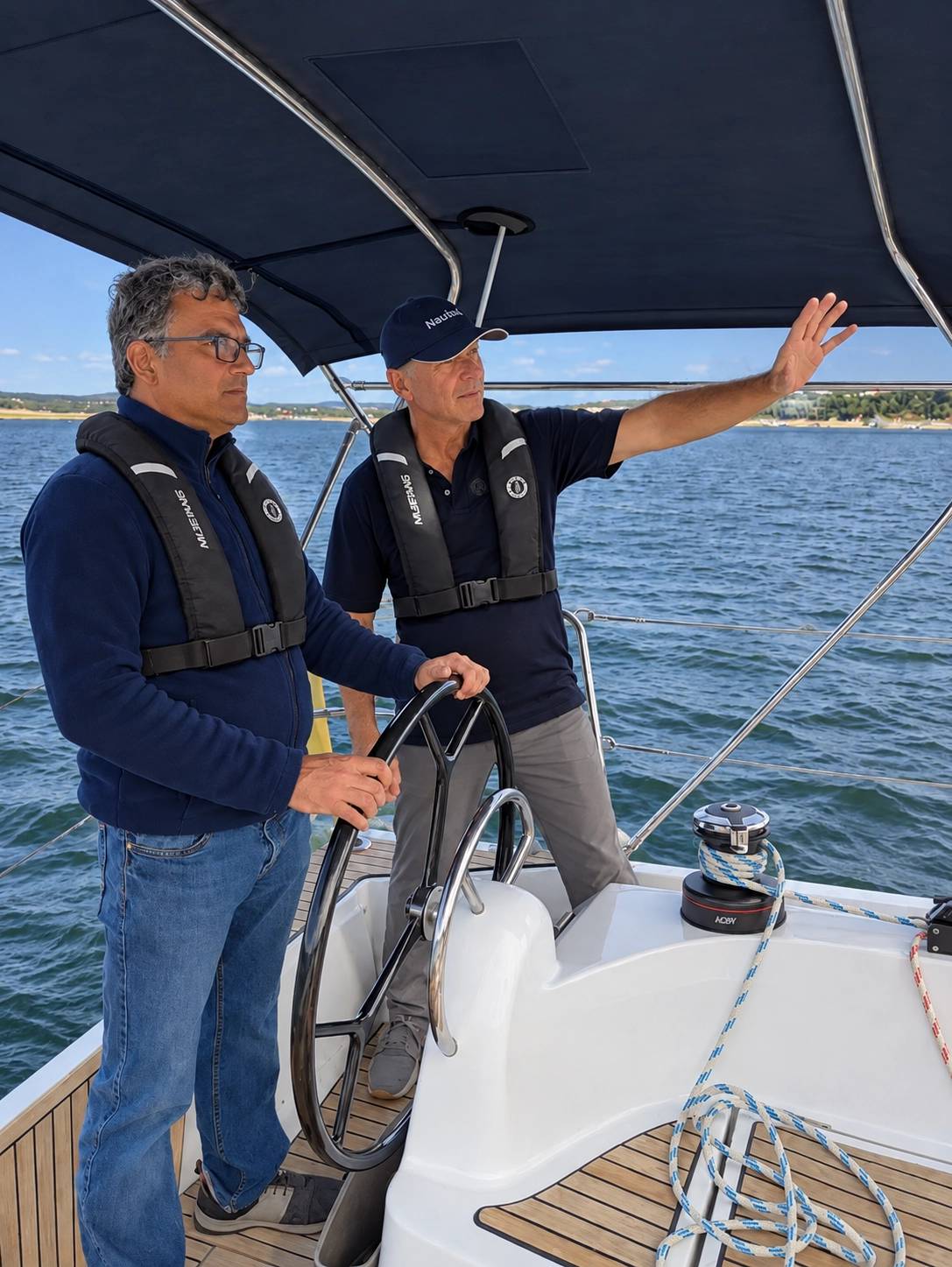
Sail with your spouse or partner, join friends for an afternoon on the water, or find opportunities through a sailing club or instructor. Ask questions, learn the boat's equipment, and take an active role in tasks appropriate to your experience.
You don't need to be the skipper to make a valuable contribution. Helping with sails, keeping lookout, handling lines, and paying attention to safety are all part of becoming someone the skipper can count on.
-
Build Your Crew Experience
Get involved whenever you sail. Help with sail handling, lines, lookout, docking, and other everyday activities under the skipper's direction. Each outing is an opportunity to become a more capable crew member.
-
Train Where You Need It
If you'd like additional instruction, a NauticEd instructor can help you develop practical crew skills, learn safe techniques, and become more comfortable participating aboard. Training can be tailored to your experience and the skills you want to improve.
-
Recognition That Grows With You
Your qualifying sailing experience is recorded in your NauticEd Logbook and reflected in your certification and Boating Resume. Successful formal instructor assessment can also add recognition of verified practical crew competence.
Ready for More?
-
BASIC SAILING & SKIPPERING
Get hands-on and take the helm.
Ready to put your sailing knowledge into practice? Work with a NauticEd instructor to steer, trim sails, tack, gybe, and learn to handle a sailboat.
Your completed Introduction to Sailing course counts toward Basic Sailing & Skippering. Develop and demonstrate your practical sailing skills with a NauticEd instructor. At least one qualifying sailing day and successful instructor-led training and assessment are required.
EXPLORE BASIC SAILING & SKIPPERING -
KEEP BUILDING YOUR
CREW SKILLSThere's always more to learn aboard.
Keep sailing with family and friends, join a sailing club, or spend more time helping with sails, lines, and maneuvers. Deepen your knowledge with NauticEd's Navigation Rules and Basic Sail Trim courses, and become an even more valuable member of the crew.
EXPLORE SAILING COURSES -

GO NOW - INSTRUCTIONAL YACHT CHARTERS
Experience a sailing vacation while you learn.
Imagine sailing from island to island with family or friends, swimming in secluded bays, and helping sail the yacht along the way. With a NauticEd instructional skipper aboard, you can help steer the vessel, trim sails, handle lines, and assist with docking and anchoring while building sailing experience in a real cruising environment.
You don't have to be the skipper to enjoy a yacht charter adventure.
EXPLORE GO NOW INSTRUCTIONAL CHARTERS
GET STARTED ON YOUR
QUALIFIED CREW CERTIFICATION
Start with NauticEd's Introduction to Sailing course and begin logging your sailing experience. Previous qualifying experience can count, and you can continue building your sailing days as you go.
START WITH INTRODUCTION TO SAILINGPrefer hands-on training?
Work with a NauticEd instructor to develop your practical crew skills
and gain experience on the water.
Frequently Asked Questions
What is NauticEd's Qualified Crew sailing certification?
Qualified Crew is NauticEd's recreational sailing certification for people who want to understand sailing, participate as capable crew members, and build meaningful experience aboard a sailboat without taking skipper responsibility.
It's designed for sailing with family, friends, or other recreational sailors aboard monohull sailboats and sailing catamarans.
Qualified Crew combines NauticEd's Introduction to Sailing online course with 10 qualifying sailing days documented in your NauticEd Logbook. An optional instructor-assessed pathway is also available.
The certification recognizes foundational sailing education and real sailing experience, rather than online course completion alone.
Is Qualified Crew suitable for complete beginners or someone sailing with a spouse or partner?
Yes. Qualified Crew is particularly suitable for beginners, occasional sailors, and people who regularly sail with a more experienced spouse, partner, family member, or friend.
It's designed for someone who wants to understand what's happening aboard, help with sails and lines, contribute to safety, and become a useful member of the crew.
You don't need previous sailing experience or another NauticEd certification to start. You build the required experience as you sail.
For many recreational sailors, becoming a capable crew member is the goal. You don't have to become a skipper to enjoy sailing and contribute meaningfully aboard.
What does a sailing crew member do?
A sailing crew member helps the skipper operate the boat safely and efficiently.
Depending on the boat, conditions, and their experience, crew members may help raise and trim sails, handle lines during tacking and gybing, steer under the skipper's direction, prepare fenders for docking, maintain lookout, and assist with anchoring or mooring.
A good crew member also communicates clearly, pays attention to changing conditions, and speaks up about possible safety concerns.
The important difference between crew and skipper is responsibility. The skipper directs the operation of the boat and makes the navigational and operating decisions. Crew members participate and assist under that direction.
Can I earn Qualified Crew certification entirely online?
No. The required Introduction to Sailing course is completed online, but Qualified Crew certification is not earned through online study alone.
You must also document 10 qualifying sailing days in your NauticEd Logbook under the normal certification pathway. A successful NauticEd instructor assessment can reduce the experience requirement from 10 to 4 qualifying sailing days.
The online course provides foundational sailing knowledge. Time aboard a sailboat allows you to experience sailing, participate in everyday crew activities, and become familiar with how a boat operates.
You can complete the education at your own pace while continuing to build your sailing experience.
Do I need sailing lessons or an instructor assessment to earn Qualified Crew?
No. You can earn Qualified Crew through completion of the required online education and 10 documented qualifying sailing days. Formal instructor-led training and practical assessment are not required for this normal pathway.
If you're new to sailing, hands-on lessons can be a great way to learn safe techniques and become more comfortable participating aboard. You can also build experience sailing with a knowledgeable skipper, friends, or a sailing club.
A successful formal instructor assessment can also provide an alternative pathway with fewer qualifying sailing days.
Training is encouraged when useful, but it isn't mandatory for the normal Qualified Crew certification.
How long does it take to earn Qualified Crew certification?
That depends mainly on how much qualifying sailing experience you already have.
You can complete NauticEd's Introduction to Sailing online course at your own pace. Under the normal pathway, you also need 10 separate qualifying sailing days, but they don't have to be consecutive.
If you already have qualifying sailing experience, enter it in your NauticEd Logbook. Otherwise, continue logging days as you sail.
There's no fixed course duration that determines when everyone earns Qualified Crew. Your certification is awarded once the applicable requirements are met.
How much does Qualified Crew certification cost?
The cost primarily depends on the required Introduction to Sailing online course and whether you choose additional on-water instruction.
The Introduction to Sailing Bundle includes the required Introduction to Sailing course, along with the recommended Navigation Rules and Basic Sail Trim courses. Current pricing is shown on the course page.
Your NauticEd Logbook and Boating Resume are free.
Instructor-led training is optional for the normal 10-day certification pathway. If you choose lessons or formal assessment, those costs are separate and vary by instructor, sailing school, location, and training needed.
How does NauticEd's certification system work?
NauticEd is a competence-based certification system. That means certification reflects more than simply completing an online course.
Our system brings together three essential elements: knowledge, on-water skills, and real sailing experience.
You demonstrate sailing knowledge through online education and testing, document qualifying experience in your free NauticEd Logbook, and can have your practical competence independently verified by a NauticEd instructor when applicable.
For Qualified Crew, the normal certification pathway requires the Introduction to Sailing course and 10 qualifying sailing days. Instructor assessment is optional.
Your achievements are recognized as you earn them. Your qualifications grow as you progress.
Unlike a one-time course certificate, your NauticEd certification and Boating Resume continue to reflect your growing sailing background.
Why is NauticEd's certification system more valuable as I gain sailing experience?
A sailing certificate shows what you've achieved, but your sailing qualifications shouldn't stop growing when you finish a course.
NauticEd's system brings together what you've learned, the practical skills you've had independently verified when applicable, and the experience you've gained.
As you continue sailing, your Logbook and Boating Resume reflect your growing experience. You can also add new coursework, instructor-verified practical competence, and additional certifications if your interests change.
Your previous qualifying experience counts, and you can work toward higher certifications without completing every lower certification first.
It's a certification system that grows with you—not just a certificate you earn once.
Why does NauticEd use interactive online education rather than relying only on textbooks?
Boating books can be helpful learning and reference resources, but in boating many concepts are much easier to understand when you can actually see them in action.
Educational research* shows the effectiveness of well-designed multimedia learning. Studies have found that animations can improve understanding compared with static illustrations, instructional videos can enhance learning, and repeated testing can improve long-term knowledge retention. These benefits are particularly relevant to boating education, where students need to understand movement, changing conditions, and practical decision-making.
NauticEd's online courses use animations, interactive illustrations, and visual explanations to help you understand how boats behave and respond to different situations. Rather than simply reading about wind direction, sail trim, docking, or navigation rules, you can see what's happening, interact with the material, and test your understanding.
Read more
*Online course research references: Berney & Bétrancourt (2016), Does Animation Enhance Learning? A Meta-Analysis, Computers & Education; Noetel et al. (2021), Video Improves Learning in Higher Education: A Systematic Review, Review of Educational Research; Roediger & Karpicke (2006), Test-Enhanced Learning: Taking Memory Tests Improves Long-Term Retention, Psychological Science; U.S. Department of Education (2010), Evaluation of Evidence-Based Practices in Online Learning: A Meta-Analysis and Review of Online Learning Studies.
Why does NauticEd require real boating experience for certification?
Boating competence takes more than knowing the theory. You need real experience applying your knowledge and developing practical skills on the water.
Conditions are never exactly the same. Docking in calm weather is different from docking in a crosswind or current. Wind, waves, traffic, weather, and unfamiliar situations all affect how you handle a boat and make decisions. Repeated experience helps develop the practical skills and judgment to respond to these changing conditions.
Read more
What makes NauticEd's Learning Management System different from simply taking online boating courses?
Putting boating courses online isn't the same as delivering effective online education.
Effective online education requires more than just posting online lessons on your site. Educational research* shows that structured learning support, progress monitoring, targeted feedback, and personalized learning interventions can improve educational outcomes. A well-designed Learning Management System brings these capabilities together to support students throughout their learning—not just while completing an individual course.
That's why NauticEd developed its own comprehensive Learning Management System (LMS) specifically for sailing and powerboating education.
Rather than simply delivering online courses, the robust system brings together your education, practical training, boating experience, certifications, and ongoing progress in one integrated platform.
Read more
*LMS research references: Du, Liu & Zhao (2025), Empowering Students in Online Learning Environments Through a Self-Regulated Learning–Enhanced Learning Management System, Behavioral Sciences; Liu, Wang & Xu (2025), The Effectiveness of Learning Analytics-Based Interventions in Enhancing Students’ Learning Effect: A Meta-Analysis of Empirical Studies, SAGE Open; Pan, Biegley, Taylor & Zheng (2024), A Systematic Review of Learning Analytics: Incorporated Instructional Interventions on Learning Management Systems, Journal of Learning Analytics; Gestiardi & Yuniawatika (2026), Learning Analytics Dashboards in Internet-Enabled Higher Education: A Meta-Analysis of Effects on Student Outcomes, Self-Regulated Learning, and Engagement, The Internet and Higher Education.
What online sailing courses are required for Qualified Crew certification?
Only NauticEd's Introduction to Sailing course is required.
It covers sailing terminology, boat parts, wind direction, points of sail, basic sail handling, tacking and gybing, knots, safety, and introductory navigation rules.
NauticEd also recommends two additional courses:
- Navigation Rules: For a deeper understanding of collision avoidance, navigation markers, and interactions between vessels.
- Basic Sail Trim: For a deeper understanding of sail behavior, wind, and effective trimming techniques.
Both are included with the Introduction to Sailing Bundle for free, but neither is required for Qualified Crew certification.
START WITH INTRODUCTION TO SAILING ›
How does NauticEd's online testing help me learn and retain boating knowledge?
NauticEd uses testing as part of the learning process, not merely as a final pass-or-fail event.
As you progress through the course, testing helps identify subjects you understand and areas needing more attention. If you don't demonstrate the required knowledge, you can return to the material, review the concepts, and retake the tests.
The approach is:
LEARN → TEST → IDENTIFY GAPS → REVIEW → RETEST → DEMONSTRATE KNOWLEDGE → APPLY ON THE WATER
Read more
Research references: Yang et al. (2021), Testing (Quizzing) Boosts Classroom Learning: A Systematic and Meta-Analytic Review, Psychological Bulletin; Roediger & Karpicke (2006), Test-Enhanced Learning: Taking Memory Tests Improves Long-Term Retention, Psychological Science; Bates et al. (2025), The Learning Benefits of Mastery Quizzing Versus Other Quizzing Methods, Psychology Learning & Teaching; Butler & Roediger (2008), Feedback Enhances the Positive Effects and Reduces the Negative Effects of Multiple-Choice Testing, Memory & Cognition; Pan & Carpenter (2023), Prequestioning and Pretesting Effects: A Review of Empirical Research, Theoretical Perspectives, and Implications for Educational Practice, Educational Psychology Review.
Is the Navigation Rules course required for Qualified Crew?
No. Introduction to Sailing already teaches basic navigation rules appropriate for beginning recreational sailors.
The separate Navigation Rules course goes into greater depth, including more complex interactions between vessels, navigation markers, and collision-avoidance situations.
We recommend taking it, particularly if you sail regularly, but it isn't necessary to complete the Qualified Crew education requirement.
The Basic Sail Trim course is also recommended rather than required.
I've already completed Introduction to Sailing. Does it count toward Qualified Crew?
Yes. If you've already completed NauticEd's Introduction to Sailing course, you've satisfied the required online education for Qualified Crew.
You don't need to repeat the course or purchase it again.
Your next step is to document the qualifying sailing experience you already have in your NauticEd Logbook and continue adding days as you sail.
If you have previously purchased NauticEd courses and later purchase a bundle, NauticEd provides appropriate credit for courses already purchased.
How much sailing experience do I need for Qualified Crew certification?
Qualified Crew normally requires 10 qualifying sailing days documented in your NauticEd Logbook.
Your qualifying experience must meet three conditions:
- At least four hours on the water per qualifying day.
- Sailboats at least 20 ft (6.1 m) long.
- Sailing experience that may be logged entirely as crew, with no skipper-day minimum.
Previous qualifying sailing experience counts.
There is also an instructor-assessed pathway. A successful formal on-water assessment with a NauticEd instructor or assessor reduces the qualifying experience requirement from 10 days to four.
What counts as a qualifying sailing day?
A qualifying sailing day includes at least four hours on the water aboard an eligible sailboat.
Four hours qualifies as one day. Eight hours on the same calendar day still counts as one day—not two.
The days don't have to be consecutive, and you don't have to earn them through a NauticEd sailing school.
For Qualified Crew, the experience must also meet the certification's sailboat-type and minimum vessel-length requirements.
Your NauticEd Logbook records your experience and identifies the days that qualify toward your certification.
What types and sizes of sailboats count toward Qualified Crew?
Qualifying experience may be earned aboard monohull sailboats or sailing catamarans 20 ft (6.1 m) or longer.
For example, qualifying sailing days aboard a 24-foot keelboat, 35-foot cruising monohull, or 42-foot sailing catamaran can all contribute toward Qualified Crew.
Sailing on smaller boats, including dinghies under 20 ft, can still be valuable experience, but those days do not count toward this certification's qualifying-day requirement.
The Qualified Crew certification itself covers recreational crew participation aboard sailboats from 20 to 56 ft (6.1–17.1 m). Qualifying experience on larger sailboats can still count; the certification's vessel scope is not an upper limit on eligible experience.
Why does NauticEd set a certification boat-length limit of 56 ft (17.1 m)?
Good question! 56 ft is not a legal limit. It is what NauticEd considers a practical upper limit for recreational sailboats and powerboats typically operated by experienced owners without professional crew. We chose a conservative figure within the approximately 55–60 ft range where owner-operation remains practical for many boaters.
By practical, we mean that these boats can generally be docked, anchored, cruised, and maintained by an experienced owner and crew. As boats become larger, moorage can become harder to find, and insurers may require additional qualifications, experience on comparable vessels, or training with a professional captain.
But a certification covering boats up to 56 ft doesn't mean you can jump from a 30-ft boat to a 56-ft yacht overnight!
Bigger boats bring different handling characteristics, more complex systems, and greater responsibilities. As a general rule: The bigger the boat, the greater the need for relevant experience, education, training, and practical skills.
The 56-ft limit defines NauticEd's certification scope. Applicable legal, licensing, insurance, and charter-company requirements remain separate.
For Qualified Crew, this vessel-size scope refers to participating as crew under a skipper’s direction, not independently operating the boat.
Can experience on sailing catamarans or powerboats count toward Qualified Crew?
Sailing catamarans count; powerboats do not.
Qualifying sailing days may be earned on monohull sailboats or sailing catamarans, provided the vessel is at least 20 ft (6.1 m) long and the day meets the minimum four-hour requirement.
Experience aboard powerboats, including power catamarans, does not count toward this sailing certification. The reason is that sailboats have specialized equipment, as well as are powered by the wind, whereas powerboats are not.
You can still record your powerboating experience in your NauticEd Logbook and Boating Resume as part of your overall boating history.
Can all 10 sailing days be logged as crew rather than skipper?
Yes. All 10 qualifying sailing days may be logged as crew.
Qualified Crew is specifically designed for people who want to participate in sailing without being responsible for skippering the boat.
You do not need to log any days as Master of Vessel, which is NauticEd's Logbook term for the person serving as skipper.
Steering temporarily under the skipper's direction or helping with sailing maneuvers does not mean you have taken independent skipper responsibility.
Can sailing experience I already have count?
Yes. Relevant sailing experience you gained before joining NauticEd can count when it meets the Qualified Crew requirements.
This includes qualifying sailing experience with a spouse or partner, family, friends, sailing clubs, or other skippers. It doesn't have to have been earned through NauticEd instruction.
Enter your previous experience accurately in your free NauticEd Logbook, including the boat, its length, your role aboard, and your time on the water.
You don't need to start accumulating sailing days from zero simply because you're new to NauticEd.
Can sailing lessons or instructional yacht charters count toward my 10 days?
Yes, when the sailing experience meets the Qualified Crew requirements.
For example, a sailing lesson or instructional charter day can count if it takes place aboard an eligible sailboat at least 20 ft long, includes at least four hours on the water, and is properly logged.
NauticEd's GO NOW instructional yacht charters provide opportunities to participate in sailing while enjoying a real yacht-chartering experience with an instructional skipper aboard.
Qualifying days on eligible monohull or sailing catamaran charters can contribute toward your certification.
EXPLORE GO NOW INSTRUCTIONAL CHARTERS ›
Do I need to own a sailboat to earn Qualified Crew?
No. Many recreational sailors gain experience without owning a boat.
You can sail with family or friends, participate through a sailing club, take sailing lessons, or join an instructional sailing trip.
Let the skipper know you're interested in becoming a more capable crew member. Ask to help with appropriate tasks, learn the boat's equipment, and become more involved each time you sail.
The important part is gaining genuine sailing experience and recording qualifying days in your NauticEd Logbook.
Why are my qualifying sailing days different from my total logged sailing days?
Your NauticEd Logbook records your sailing history, but not every logged day necessarily qualifies toward a particular certification.
Qualified Crew has requirements for boat type, minimum sailboat length, and time on the water.
For example, a day sailing a 16-foot dinghy can remain part of your sailing history without increasing your Qualified Crew qualifying-day total. Similarly, an outing that doesn't meet the minimum four-hour requirement won't count as a qualifying day.
Your qualifying-day count reflects the experience that meets this certification's requirements.
What on-water skills and practical knowledge should a capable recreational sailing crew member have?
A capable recreational sailing crew member should understand how sailing works, communicate effectively with the skipper, and participate safely in sailing and everyday tasks aboard, without taking independent skipper responsibility.
Instructor training and assessment are optional for earning Qualified Crew certification through the normal education-and-experience pathway. Whether you're new to sailing or already have experience, you can develop your crew skills through sailing with knowledgeable skippers, family, friends, or sailing clubs. However, completing the Introduction to Sailing course and documenting 10 qualifying sailing days does not, by itself, independently verify all your practical crew capabilities.
The important goal is to develop the knowledge, practical skills, and experience to participate safely and become a capable, helpful member of the crew.
The following areas provide a practical guide to developing your crew skills and identifying where additional experience or focused training may be valuable. These are skills to learn and practice as you gain sailing experience, not additional certification requirements or a mandatory practical assessment checklist.
- UNDERSTAND THE BASICS OF SAILING — Recognize the main parts of a sailboat, understand common sailing terms, and learn how wind direction and sail trim affect the boat. Understand what happens during tacking and gybing, recognize different points of sail, and become familiar with common skipper instructions.
- HELP WITH SAILS, LINES & MANEUVERS — Learn how to assist with raising, trimming, and lowering sails. Handle basic lines, become familiar with useful sailing knots, and help during tacking and gybing under the skipper's direction. You may also take a turn steering the boat when appropriate. Understand the dangers of loaded lines, winches, and moving rigging.
- ASSIST WITH DEPARTURE, DOCKING & ANCHORING — Help prepare the boat for departure, handle dock lines and fenders, assist with mooring or anchoring tasks, and secure equipment when sailing is done. Learn to recognize hazards associated with moving boats, loaded lines, winches, and deck equipment. Never attempt to stop a moving boat using your hands, feet, or body.
- UNDERSTAND BASIC NAVIGATION RULES & KEEP LOOKOUT — Understand basic collision-avoidance rules and recognize common navigation markers. Help watch for other vessels, obstacles, swimmers, and changing conditions. Communicate anything that may require the skipper's attention.
- CONTRIBUTE TO SAFETY ABOARD — Know how to select, fit, and use an appropriate life jacket/PFD, move safely around a sailboat, and recognize common hazards such as the boom and heavily loaded lines. Know where safety and emergency equipment is located. Understand basic emergency procedures, including raising the alarm if someone falls overboard and helping as directed.
A capable crew member also pays attention, asks questions, anticipates familiar tasks, and speaks up about safety concerns.
Use these areas to develop your crew skills and identify where additional practice, experience, or instruction may be valuable. They are not a mandatory checklist of independently assessed skills for the normal Qualified Crew certification.
What qualifications and quality standards do NauticEd instructors meet?
NauticEd instructors must meet established experience, education, teaching, and practical standards. But our commitment to instructor quality doesn't stop when an instructor is approved. NauticEd maintains ongoing quality control through student feedback, management oversight, and publicly available instructor reviews.
Read more
Your instructor's quality matters. Being an experienced sailor or boater doesn't automatically make someone an effective teacher. NauticEd's combination of qualification requirements, American National Standards, individual approval, ongoing management oversight, and transparent student reviews is designed to help students receive high-quality instruction and make informed choices.
FIND A NAUTICED ON-WATER INSTRUCTOR ›
What should I know if I regularly sail with just my spouse or partner?
When only two people are aboard, being a knowledgeable crew member can make a significant difference.
You might help handle a line while your partner steers, prepare fenders for docking, maintain lookout, or help manage the sails during a maneuver.
It's also wise for both people to discuss what to do if the skipper becomes ill, injured, or unable to operate the boat.
Knowing how to raise an emergency alarm, summon assistance, locate safety equipment, and understand the boat's basic emergency procedures is especially valuable.
Additional hands-on emergency training is a good idea for couples who regularly sail together, even when one person normally takes skipper responsibility.
What should a sailing crew member do if someone falls overboard?
The immediate priorities are to raise the alarm, alert the skipper, and maintain sight of the person in the water.
A crew member can help by pointing continuously toward the person, communicating their location, and assisting with flotation equipment and recovery preparations as directed.
It's important to understand the boat's crew-overboard procedures before an emergency happens. The skipper should explain how crew members can help and where safety equipment is located.
You should also practice crew-overboard procedures in case the skipper goes overboard! Learning the fundamentals of sailing is especially important in this regard - you learn the basic skills needed to operate the sailboat in an emergency.
As a best practice, the skipper should brief the crew on emergency procedures before casting off, as well as practice crew-overboard if you’re not familiar with the boat. If the skipper does not brief the crew, then speak up!
Entering the water for an unplanned rescue can create additional danger and should not be attempted without an appropriate rescue plan.
Does Qualified Crew certification mean my practical sailing skills have been assessed by an instructor?
Not necessarily.
Under the normal pathway, Qualified Crew certification recognizes completion of the required online sailing education and documented qualifying sailing experience. It does not mean a NauticEd instructor has independently assessed every practical sailing skill.
That pathway earns a Certificate of Nautical Achievement.
If you successfully complete an applicable formal instructor assessment, NauticEd can separately recognize your verified practical crew competence through a Certificate of Nautical Competence.
On a digital credential, Instructor Assessed indicates formal verification of the applicable practical competence. Not Assessed means no such assessment is recorded; it does not indicate failure or diminish the certification earned through the normal education-and-experience pathway.
Do I need a sailing crew certification just to go sailing?
Generally, no. People regularly sail with family and friends without holding a formal sailing crew certification.
However, a sailing club, school, charter operator, or other organization may have its own training or participation requirements. Qualified Crew provides documented recognition of your foundational sailing education and qualifying experience.
It can also help you identify what to learn as you become more actively involved in sailing.
Can I skipper, rent, or bareboat charter a sailboat with Qualified Crew certification?
Qualified Crew is not a skipper certification and does not establish independent skipper qualifications.
It's designed for someone participating aboard a recreational sailboat under the direction of a skipper.
You may practice steering or boat handling under the skipper's direction, but that is different from taking responsibility for operating the vessel yourself.
If your goal is to independently operate, rent, or bareboat charter a sailboat, NauticEd offers separate skipper certifications.
Rental companies and charter operators make their own approval decisions based on the boat, sailing experience, qualifications, and applicable local requirements.
Is Qualified Crew a sailing license?
No. Qualified Crew is a recreational sailing certification, not a sailing or boating operator's license.
It documents completion of NauticEd's required foundational sailing education and qualifying sailing experience.
A sailing license or other boating credential may be required for certain operating activities or destinations, but that is separate from Qualified Crew certification.
Qualified Crew is intended for someone sailing as crew under a skipper's direction, not someone seeking an international license to independently operate or charter a yacht.
Is Qualified Crew a professional maritime crew certification?
No. Qualified Crew is designed for recreational sailing, not professional maritime employment.
It recognizes foundational sailing knowledge and documented recreational experience participating aboard a sailboat under the direction of a skipper.
Professional yacht crew and commercial maritime positions may require separate training, experience, safety qualifications, or maritime credentials appropriate to the role and jurisdiction.
Qualified Crew should not be confused with professional deckhand qualifications or commercial mariner certification.
Can Qualified Crew help me join a sailing club or find opportunities to sail as crew?
It can provide a useful record of your sailing background.
Your Qualified Crew certification and NauticEd Boating Resume show the sailing education you've completed and the qualifying experience you've documented.
A sailing club or skipper may find that information helpful when learning about your background, but each club or organizer determines its own participation and crew requirements.
You don't need to own a sailboat to keep developing as crew. Sailing clubs, friends, local sailing schools, and instructional charters can all provide opportunities to gain experience.
What is the difference between Qualified Crew and Basic Sailing & Skippering?
Both are NauticEd beginner sailing certifications, but they serve different purposes.
Qualified Crew is for someone who wants to understand sailing and build experience as an active crew member without taking skipper responsibility. It requires Introduction to Sailing plus normally 10 qualifying sailing days. Instructor assessment is optional.
Basic Sailing & Skippering is for someone who wants hands-on instruction to develop practical sailing, boat-handling, and introductory skippering skills. It requires Introduction to Sailing, at least one qualifying sailing day, and successful instructor-led practical training and assessment.
Basic Sailing & Skippering offers two instructor-determined certifications: Basic Sailing Skills & Knowledge and Basic Skippering Skills & Knowledge.
Neither certification is a prerequisite for the other. Choose the one that best matches how you want to participate in sailing.
Do I automatically earn Basic Sailing & Skippering when I earn Qualified Crew, or vice versa?
No. The two certifications have different requirements.
However, both use Introduction to Sailing as their required foundational online education, so you don't need to complete that course twice.
To earn Basic Sailing & Skippering, you'll need to meet its separate requirements, including instructor-led practical training, successful assessment, and at least one qualifying sailing day.
Likewise, earning Basic Sailing & Skippering doesn't automatically award Qualified Crew. You must still satisfy Qualified Crew's separate sailing-experience requirement.
A properly logged Basic Sailing training day can contribute toward Qualified Crew when it meets the applicable vessel-size and minimum time-on-water rules.
Do I need Qualified Crew before earning a NauticEd skipper certification?
No. NauticEd does not require you to earn Qualified Crew or Basic Sailing & Skippering before beginning a skipper certification.
You can start working toward the certification that matches your sailing goals, experience, and the responsibility you want to take on.
Qualified Crew is appropriate if you primarily want to participate as crew. If you want to independently skipper a smaller keelboat, Skipper Small Keelboat may be more appropriate.
Both directions are legitimate, and there's no mandatory certification sequence.
What can I do after earning Qualified Crew?
You have several options, depending on what interests you.
- Keep sailing as crew: Continue sailing with friends, family, or a sailing club. Become more familiar with different boats, conditions, and everyday sailing tasks.
- Develop hands-on sailing skills: Take Basic Sailing & Skippering with a NauticEd instructor to practice boat handling and begin developing introductory skippering skills.
- Enjoy an instructional yacht charter: Join a NauticEd GO NOW sailing vacation with an instructional skipper aboard, participating in sailing and cruising while building experience.
- Deepen your sailing knowledge: Take Navigation Rules and Basic Sail Trim to become more knowledgeable and useful aboard.
- Work toward becoming a skipper: If you eventually want to take responsibility for operating a smaller keelboat yourself, explore Skipper Small Keelboat and its separate requirements.
There's no required certification sequence. You can continue enjoying sailing as crew or pursue additional training when your interests change.
Is NauticEd Qualified Crew equivalent to RYA Competent Crew?
They serve a similar recreational crew audience, but they are different certifications with different requirements.
The RYA Competent Crew course is a hands-on sailing course, normally completed over five days, with practical performance assessed during training aboard a cruising yacht.
NauticEd Qualified Crew combines foundational online sailing education with normally 10 documented qualifying sailing days aboard eligible monohulls or sailing catamarans. Formal instructor assessment is optional under the normal pathway.
Both are intended to help people become useful recreational sailing crew, but they use different approaches to education, practical development, and recognition.
One credential should not be assumed to automatically satisfy the other's requirements.
EXPLORE NAUTICED QUALIFIED CREW REQUIREMENTS ›
READY TO BECOME CAPABLE CREW?
Start with NauticEd's Introduction to Sailing course and begin logging your sailing experience. Previous qualifying experience can count, and you can continue building your sailing days as you go.
Start with Online CoursesQUESTIONS? WE'RE HERE TO HELP.
Not sure which certification is right for you, what experience counts, or where to begin?
Contact us at [email protected].