
SKIPPER SMALL KEELBOAT CERTIFICATION - SAILING
NauticEd's Skipper Small Keelboat Certification recognizes sailors who have completed the required sailing education and documented qualifying experience for taking skipper responsibility aboard smaller monohull keelboats, typically for local and day sailing.
- For sailing smaller keelboats, typically up to about 25 ft (7.6 m): Build the knowledge and experience to handle boat balance, tiller and rudder steering, sail trim, tacking and gybing, and outboard engines where fitted.
- Built around skipper responsibility: Decide whether conditions are suitable, prepare the boat, apply navigation rules, direct passengers or crew, respond to emergencies, and return safely.
- Certification is earned through required sailing education and documented qualifying experience. Additional instructor training helps develop on-water skills, while formal assessment can independently verify practical competence.
- No prior NauticEd certification is required. Previous qualifying sailing experience can count toward your certification.
U.S. COAST GUARD RECOGNIZED STANDARDS
The U.S. Coast Guard and NASBLA recognize NauticEd as meeting American National Standards.
Independent verification. Nationally recognized standards.
Independent standards matter. Anyone can create their own standard. The difference with NauticEd is that we meet an independent national standard rather than simply creating our own.
For Skipper Small Keelboat, NauticEd's on-water sailing program has been independently third-party verified by NASBLA as meeting the American National Standard for on-water sailboat skills.
Independent standards provide an outside benchmark for competence — adding credibility to your certification and confidence that the knowledge and skills behind it reflect recognized requirements for real-world boating.

WHAT THIS CERTIFICATION HELPS YOU DO
For sailors ready to take responsibility for smaller keelboats, typically up to about 25 ft (7.6 m), during local and day sailing.
-

TAKE THE HELM OF A SMALLER KEELBOAT
Take responsibility for the boat yourself — deciding whether conditions are suitable, preparing the boat and crew, planning your outing, and managing the sail from departure through return.
-

SAIL & CONTROL THE BOAT
Learn to manage boat balance and weight placement, steer with a tiller or wheel, adjust sail trim, tack and gybe, sail on different points of sail, and reef when appropriate. Keep the boat under control as conditions change.
-

OPERATE SAFELY WITH PASSENGERS & CREW
Maintain a proper lookout, apply navigation rules, communicate clearly with passengers and crew, use appropriate safety equipment, and respond to emergencies such as a crew-overboard situation.
-

RETURN & SECURE THE BOAT
Prepare for arrival, make a controlled approach under sail or power, operate an outboard engine where fitted, lower the sails, dock or moor safely, and leave the boat properly secured.
No prerequisite certification is required - the program includes the supporting education you need.
Start with Online Courses
SKIPPER SMALL KEELBOAT CERTIFICATION REQUIREMENTS
Complete the required sailing education, document your qualifying experience, and receive your certification.
-
1
COMPLETE THE REQUIRED ONLINE EDUCATION
The Skipper Small Keelboat Course Bundle includes:
Start with Online Courses- Skipper Small Keelboat (required)
- Navigation Rules* (optional, free)
- Basic Sail Trim (optional, free, recommended)
*The Skipper Small Keelboat course already introduces basic navigation rules, while the Navigation Rules course goes into more detail.
Already know the material? Go straight to the test for topics you're familiar with and focus your time on new learning or where you need a refresher.
-
2
BUILD YOUR ON-WATER SKILLS
On-water competence matters. Build on the skills and experience you already have, with NauticEd instructors available for additional training or, where applicable, independent verification of practical competence.
- Already experienced and skilled? You can earn your certification without instructor training or assessment by completing the required online courses and documenting qualifying sailing experience. See Skipper Small Keelboat on-water skill expectations
- Build your skills. Develop the practical skills to handle smaller keelboats, manage boat balance and weight placement, steer and control the boat, trim sails, tack and gybe, operate an outboard engine where fitted, and safely manage departure, arrival, and emergencies.
- Want to fill skill gaps or verify your skills? Work with an instructor to evaluate your skills, identify and address gaps, build relevant experience, or have your practical competence independently verified for your certification.
NauticEd instructors tailor training to your existing skills, experience, and goals, so you focus your time on the water developing the skills you actually need. More info
-
3
DOCUMENT YOUR SAILING EXPERIENCE
To earn your Skipper Small Keelboat certification, normally* you must document 10 qualifying sailing days in your free NauticEd Logbook. Your qualifying days must include:
- At least 5 days as Master (skipper) of a sailing vessel.
- All qualifying days on sailboats 20 ft (6.1 m) or longer.
These requirements can overlap. Prior sailing experience counts when it meets the qualifying requirements. You don't need all 10 days before you begin.
*Instructor-Assessed Pathway: A successful formal on-water assessment with a NauticEd instructor or assessor reduces the experience requirement to 4 qualifying sailing days on sailboats 20 ft (6.1 m) or longer. The normal Master-of-Vessel minimum is waived.
You can achieve Skipper Small Keelboat without instructor training, in which case the 10 qualifying days are required for recognition.
-
4
MEET THE REQUIREMENTS. RECEIVE YOUR CERTIFICATION
NauticEd automatically tracks your completed online courses, instructor sign-offs, and qualifying sailing experience. Once you meet the requirements, your Skipper Small Keelboat certification is awarded.
Your free Resume brings together your education, boating experience, certifications and, when applicable, instructor-assessed practical competence.
ON-WATER SKILLS, TRAINING & ASSESSMENT
Are you ready for the responsibility?
For Skipper Small Keelboat certification, on-water competence means being ready to take responsibility for a smaller keelboat and everyone aboard during local and day sailing.
That goes well beyond simply knowing how to sail. On smaller keelboats, boat balance, weight placement, sail trim, and rudder or tiller control all work together. You may be tacking and gybing, reefing as conditions change, operating an outboard engine where fitted, maneuvering near other boats, docking or mooring, or responding to an emergency.
As skipper, you also have to prepare the boat, brief and direct passengers or crew, and make safe decisions throughout the outing. When the wind shifts, traffic develops, or a maneuver doesn't go as planned, you're responsible for keeping the boat under control and making the right decisions.
Compare sailing risk & responsibilities
CHECK YOUR ON-WATER READINESS
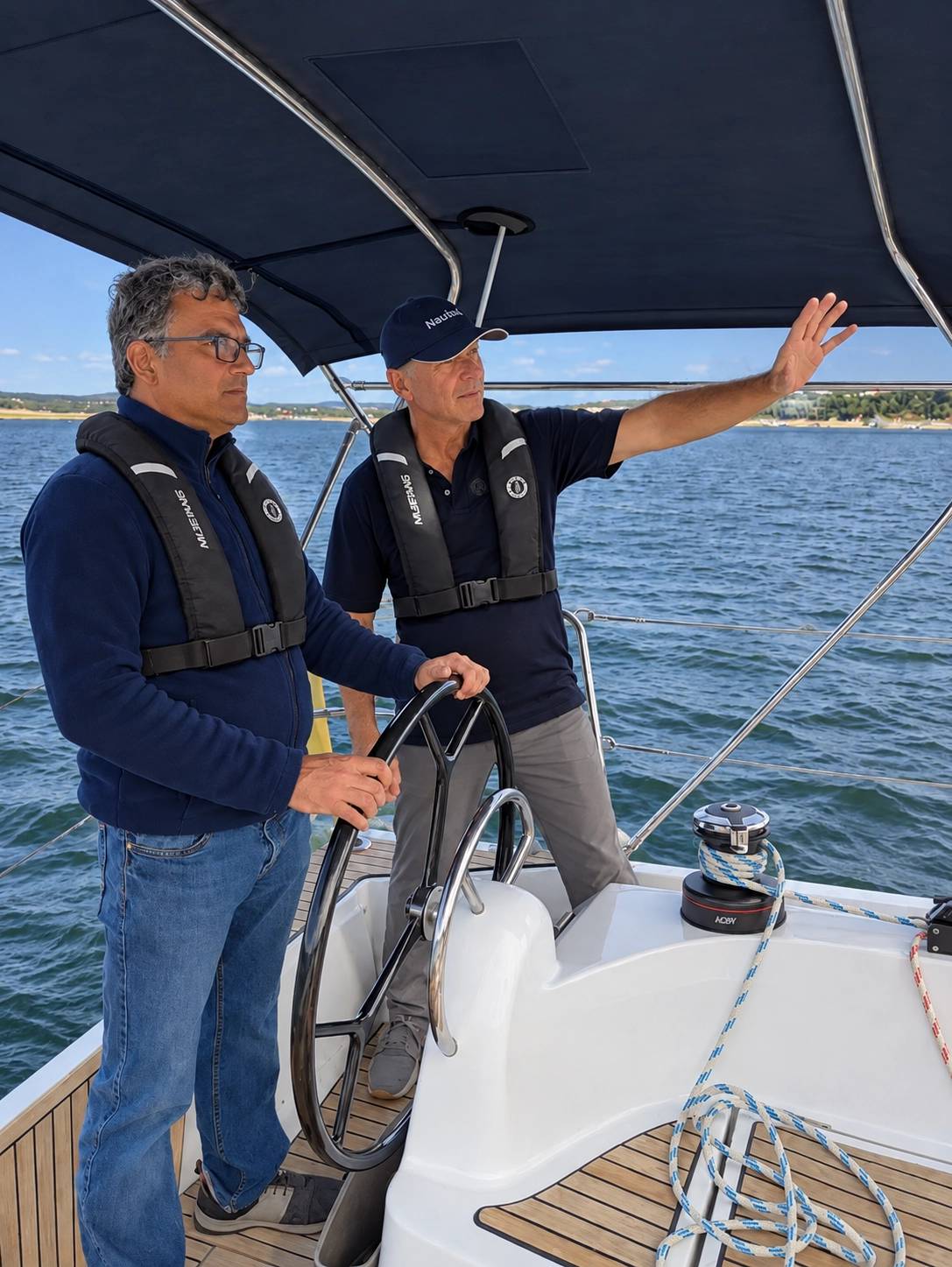
How do you know what you don’t know? Skippering a small keelboat during local and day sailing involves numerous practical skills and skipper responsibilities, and experience doesn't always expose you to all of them.
Consider your actual experience with boat balance and crew weight placement, tiller and rudder control, sail trim, tacking and gybing, reefing, outboard operation where fitted, navigation rules, crew-overboard recovery, and safely managing departure, arrival, docking, and mooring. Identify where additional practice or focused training would be valuable before taking skipper responsibility.
If you're already experienced and skilled, instructor training and assessment are optional for Skipper Small Keelboat certification. If you're unsure of your readiness, a NauticEd instructor can help identify gaps and recommend whether focused training or additional on-water experience is needed.
See Skipper Small Keelboat on-water skill expectations-
Train where you need it
Build the practical skills involved in handling and managing a smaller keelboat: boat balance, steering and rudder control, sail handling and trim, tacking and gybing, outboard operation, navigation rules, safety and emergency procedures, docking, and securing the boat.
-
Verify Your On-Water Competence
For sailors who want independent verification, an on-water assessment with a NauticEd instructor or assessor can verify practical competence. The assessment may be completed on its own or combined with training.
-
Recognition That Grows With You
Your completed education, qualifying sailing experience, and instructor-verified practical competence, when earned, are reflected in your NauticEd certification and Boating Resume. Your achievements are recognized as you earn them, and your qualifications grow as you progress.
SAILING CERTIFICATIONS - RISK & RESPONSIBILITY
Small keelboats are often sailed close to shore, but that doesn't mean every outing is low-risk. A sudden gust, shifting crew weight, an unexpected gybe, nearby boat traffic, or a difficult approach to the dock can require quick decisions. On smaller boats, changes in balance, sail trim, and steering (often coordinating the tiller with the outboard) can have an immediate effect on boat control.
While small keelboats are typically more maneuverable and responsive than larger “stiff” keelboats, they’re also more “tender” and heel quickly in gusts or moderate wind - even crew movement can affect the balance of the boat. Even experienced large keelboat sailors often find sailing small keelboats challenging, especially adapting from a wheel to a tiller and the performance nuances of small keelboats.
As skipper, you're responsible for deciding whether conditions are suitable, keeping everyone aboard safe, anticipating hazards, and knowing when to reduce sail, change plans, or return early. Help may be nearby, but you're responsible for the boat and everyone aboard.
With NauticEd, you're not just taking our word for what it takes to skipper a sailboat safely. Our on-water sailing program has been independently verified by NASBLA as meeting a nationally recognized standard for practical sailing skills. This gives you added confidence that your training is built around established standards for safe, competent sailing — not just our own checklist.
Ready for More?
-

STEP UP TO LARGER KEELBOATS
Ready to move beyond smaller keelboats and take responsibility for a larger sailboat and the comfort and greater range they offer?
Skipper Large Keelboat builds on your sailing foundation with the additional boat handling, maneuvering under power, docking, anchoring, onboard systems, and crew management that come with larger boats.
EXPLORE SKIPPER LARGE KEELBOAT -

BUILD MORE SAILING SKILLS
Keep developing the skills that make you a more capable skipper. Refine your sail trim, boat balance, tiller control, and maneuvering skills through practice on the water. Expand your knowledge of navigation, docking, anchoring, weather, and other subjects as your sailing experience and goals grow.
VIEW SAILING COURSES
GET STARTED ON YOUR SKIPPER
SMALL KEELBOAT CERTIFICATION
Start with the required online courses and build from there, or find an instructor to discuss on-the-water training.
Buy the Online CoursesPrefer hands-on training?
Find an InstructorFrequently Asked Questions
What is NauticEd's Skipper Small Keelboat certification?
Skipper Small Keelboat is NauticEd's recreational sailing certification for sailors preparing to take responsibility for smaller monohull keelboats during local and day sailing.
It combines required online sailing education with documented qualifying sailing experience. The certification focuses on safely managing a small keelboat, including sail handling, boat balance, steering, departure and arrival, navigation rules, emergencies, and responsibility for passengers or crew.
A NauticEd instructor can provide hands-on training and independently verify your practical competence through a formal on-water assessment.
What size sailboat is Skipper Small Keelboat certification designed for?
Skipper Small Keelboat is designed for monohull keelboats from 20 to 27 ft (6.1–8.2 m), with a typical focus on smaller keelboats up to approximately 25 ft (7.6 m).
These boats are commonly used for day sailing, sailing clubs, recreational outings, and learning to skipper independently.
The certification focuses on the sailing, boat handling, safety, and decision-making responsibilities associated with these smaller keelboats.
The size of boat covered by the certification is different from the size of boat on which qualifying sailing experience may be earned. Experience aboard larger sailboats may also count.
What is a keelboat, and how is it different from a sailing dinghy?
A keelboat is a sailboat with a keel beneath the hull that helps resist sideways movement and contributes to stability. Many keelboats have ballast incorporated into the keel.
Smaller keelboats are typically more stable than unballasted sailing dinghies, but they can still be sensitive to crew weight, wind changes, and sail trim. They may heel significantly in gusts or stronger winds.
Small keelboats commonly have tiller steering and may use an outboard engine for propulsion when not sailing. Fun fact: an engine is considered “auxiliary” or secondary power on a sailboat - wind and sails are your main propulsion…
NauticEd's Skipper Small Keelboat certification focuses on the handling characteristics and responsibilities involved in independently skippering these smaller boats.
Who is Skipper Small Keelboat certification for?
It's for sailors who want to independently skipper a smaller keelboat, whether they own a boat, are considering buying one, sail through a club, or hope to rent a suitable sailboat.
You might be:
- A newer sailor working toward taking friends or family sailing.
- An experienced crew member ready to become the skipper.
- A small-keelboat owner who wants to strengthen and document their qualifications.
- An experienced sailor looking to improve smaller-boat handling skills.
What online courses are required for Skipper Small Keelboat certification?
The Skipper Small Keelboat Course Bundle includes three required courses:
- Skipper Small Keelboat
- Navigation Rules
- Basic Sail Trim
You receive credit for NauticEd courses you've already purchased.
Already know the material? You can go straight to the tests for familiar topics and focus your learning on new subjects or areas needing review.
Start with Online Courses ›
Can I earn Skipper Small Keelboat certification entirely online?
No.
You complete the required sailing knowledge and theory online, but certification also requires qualifying sailing experience documented in your free NauticEd Logbook.
Normally, this means 10 qualifying sailing days, including at least five days as skipper.
Successful formal on-water assessment provides an alternative pathway with four qualifying sailing days.
Instructor-led training and formal assessment are optional for skilled, experienced sailors who meet the normal certification requirements. A successful assessment independently verifies your practical competence and adds that recognition to your credentials.
Do I need Qualified Crew or Basic Sailing & Skippering before starting Skipper Small Keelboat?
No. NauticEd does not require you to earn another certification first.
You can begin working toward Skipper Small Keelboat directly, whether you're relatively new to sailing or already have substantial experience.
Qualified Crew focuses on developing sailing knowledge and experience while participating under another skipper's direction. Basic Sailing & Skippering focuses on introductory instructor-led practical development.
Both can be useful preparation, but neither is a mandatory prerequisite.
What is the difference between Basic Sailing & Skippering and Skipper Small Keelboat?
The main difference is the responsibility and accomplishment each certification recognizes.
Basic Sailing & Skippering is an instructor-led beginner certification. It introduces practical sailing, boat handling, and foundational skippering skills. Your instructor evaluates your performance and awards the appropriate Basic Sailing Skills or Basic Skippering Skills recognition.
Skipper Small Keelboat is a fuller skipper certification for taking responsibility for a smaller keelboat yourself. It requires its own online education and qualifying sailing experience, with the option to have practical skipper competence independently verified.
Basic Sailing is a useful starting point for beginners who want hands-on instruction. Skipper Small Keelboat is the more appropriate certification when your goal is to develop and document independent small-keelboat skipper qualifications.
Can I start Skipper Small Keelboat if I've never sailed before?
Yes. You can begin the online education immediately, and no previous NauticEd certification is required.
However, Skipper Small Keelboat represents genuine responsibility for operating a sailboat and keeping people aboard safe.
If you're completely new to sailing, we recommend starting with foundational online education and speaking with a NauticEd instructor about an appropriate on-water training plan.
An instructor can help you develop sailing, boat-handling, safety, and skipper skills while you build qualifying experience.
You don't have to earn every introductory certification first, but you do need to develop the skills and experience appropriate to taking skipper responsibility.
How much does Skipper Small Keelboat certification cost?
The cost depends on the required online coursework and whether you choose additional on-water training or formal practical assessment.
Current course and bundle pricing is shown on NauticEd's sailing course pages. You receive credit for courses you've already purchased.
On-water instruction and formal assessment are arranged separately with NauticEd instructors or sailing schools. Costs vary by location, boat, instructor, and the amount of training or assessment needed.
Skilled, experienced sailors can earn Skipper Small Keelboat through the normal education-and-experience pathway without paying for instructor training or formal assessment.
How does NauticEd's certification system work?
NauticEd is a competence-based certification system. That means your certification reflects more than completing a course — our system brings together three essential elements: knowledge, on-water skills, and real sailing experience — to build truly competent sailors who take on real-world sailing responsibilities.
A competence-based certification goes beyond completing a sailing course. You demonstrate your knowledge through online testing, document qualifying experience in your free NauticEd Logbook, and can have your practical competence independently verified by a NauticEd instructor. Instructor training and assessment requirements vary by certification.
Your achievements are recognized as you earn them. Your qualifications grow as you progress. Unlike a one-time course certificate, your NauticEd certification and Boating Resume reflect your growing qualifications as you gain experience and earn additional recognition — automatically!
Why is NauticEd's certification system more valuable as I gain experience?
A sailing certificate shows what you've achieved, but your sailing qualifications shouldn't stop growing when you finish a course.
NauticEd's system recognizes your continuing development, bringing together what you've learned, the practical skills you've had independently verified, and the experience you've gained.
Your previous qualifying experience counts, and you can work toward higher certifications without having to complete every lower certification first.
As you build experience, your NauticEd certification and Boating Resume become increasingly useful for demonstrating your qualifications to charter companies, instructors, marine insurers, and others who evaluate your boating background.
It's a certification system that grows with you — not just a certificate you earn once.
Why does NauticEd use interactive online education rather than relying only on textbooks?
Boating books can be helpful learning and reference resources, but in boating many concepts are much easier to understand when you can actually see them in action.
Educational research* shows the effectiveness of well-designed multimedia learning. Studies have found that animations can improve understanding compared with static illustrations, instructional videos can enhance learning, and repeated testing can improve long-term knowledge retention. These benefits are particularly relevant to boating education, where students need to understand movement, changing conditions, and practical decision-making.
NauticEd's online courses use animations, interactive illustrations, and visual explanations to help you understand how boats behave and respond to different situations. Rather than simply reading about wind direction, sail trim, docking, or navigation rules, you can see what's happening, interact with the material, and test your understanding.
Read more
*Online course research references: Berney & Bétrancourt (2016), Does Animation Enhance Learning? A Meta-Analysis, Computers & Education; Noetel et al. (2021), Video Improves Learning in Higher Education: A Systematic Review, Review of Educational Research; Roediger & Karpicke (2006), Test-Enhanced Learning: Taking Memory Tests Improves Long-Term Retention, Psychological Science; U.S. Department of Education (2010), Evaluation of Evidence-Based Practices in Online Learning: A Meta-Analysis and Review of Online Learning Studies.
Why does NauticEd require real boating experience for certification?
Boating competence takes more than knowing the theory. You need real experience applying your knowledge and developing practical skills on the water.
Conditions are never exactly the same. Docking in calm weather is different from docking in a crosswind or current. Wind, waves, traffic, weather, and unfamiliar situations all affect how you handle a boat and make decisions. Repeated experience helps develop the practical skills and judgment to respond to these changing conditions.
Read more
How does NauticEd's online testing help me learn and retain boating knowledge?
NauticEd uses testing as part of the learning process, not merely as a final pass-or-fail event.
As you progress through the course, testing helps identify subjects you understand and areas needing more attention. If you don't demonstrate the required knowledge, you can return to the material, review the concepts, and retake the tests.
The approach is:
LEARN → TEST → IDENTIFY GAPS → REVIEW → RETEST → DEMONSTRATE KNOWLEDGE → APPLY ON THE WATER
Read more
Research references: Yang et al. (2021), Testing (Quizzing) Boosts Classroom Learning: A Systematic and Meta-Analytic Review, Psychological Bulletin; Roediger & Karpicke (2006), Test-Enhanced Learning: Taking Memory Tests Improves Long-Term Retention, Psychological Science; Bates et al. (2025), The Learning Benefits of Mastery Quizzing Versus Other Quizzing Methods, Psychology Learning & Teaching; Butler & Roediger (2008), Feedback Enhances the Positive Effects and Reduces the Negative Effects of Multiple-Choice Testing, Memory & Cognition; Pan & Carpenter (2023), Prequestioning and Pretesting Effects: A Review of Empirical Research, Theoretical Perspectives, and Implications for Educational Practice, Educational Psychology Review.
How is NauticEd's online supplemental sailing education different from American Sailing (ASA)?
NauticEd produces supplemental sailing instruction, including videos from experienced instructors and industry experts. Many of those videos are made freely available through YouTube and social media. When a video supports a formal NauticEd lesson, it may also be incorporated into the course.
By comparison, American Sailing (ASA) maintains a catalog of supplemental online classes that are mostly just videos, and they charge a fee to access them.
The distinction is important.
NauticEd does not require someone to purchase a separate video class every time they want a useful piece of supplemental instruction. Much of that instructional video is freely available. The paid NauticEd online course is the structured educational product.
Read more
*Relevant educational research: Zhang et al. (2025), Active Learning Strategies in Video Learning: A Meta-Analysis, Educational Research Review; Yang et al. (2021), Testing (Quizzing) Boosts Classroom Learning: A Systematic and Meta-Analytic Review, Psychological Bulletin; Winget & Persky (2022), A Practical Review of Mastery Learning, American Journal of Pharmaceutical Education.
What makes NauticEd's Learning Management System different from simply taking online boating courses?
Putting boating courses online isn't the same as delivering effective online education.
Effective online education requires more than just posting online lessons on your site. Educational research* shows that structured learning support, progress monitoring, targeted feedback, and personalized learning interventions can improve educational outcomes. A well-designed Learning Management System brings these capabilities together to support students throughout their learning - not just while completing an individual course.
That's why NauticEd developed its own comprehensive Learning Management System (LMS) specifically for sailing and powerboating education.
Rather than simply delivering online courses, the robust system brings together your education, practical training, boating experience, certifications, and ongoing progress in one integrated platform.
Read more
*LMS research references: Du, Liu & Zhao (2025), Empowering Students in Online Learning Environments Through a Self-Regulated Learning–Enhanced Learning Management System, Behavioral Sciences; Liu, Wang & Xu (2025), The Effectiveness of Learning Analytics-Based Interventions in Enhancing Students’ Learning Effect: A Meta-Analysis of Empirical Studies, SAGE Open; Pan, Biegley, Taylor & Zheng (2024), A Systematic Review of Learning Analytics: Incorporated Instructional Interventions on Learning Management Systems, Journal of Learning Analytics; Gestiardi & Yuniawatika (2026), Learning Analytics Dashboards in Internet-Enabled Higher Education: A Meta-Analysis of Effects on Student Outcomes, Self-Regulated Learning, and Engagement, The Internet and Higher Education.
How much sailing experience do I need for Skipper Small Keelboat certification?
Normally, Skipper Small Keelboat requires 10 qualifying sailing days documented in your NauticEd Logbook.
Your 10 days must include:
- At least five days as Master of Vessel (skipper).
- All qualifying days on sailboats 20 ft (6.1 m) or longer.
There is also an instructor-assessed pathway. If a NauticEd instructor or assessor successfully verifies your Skipper Small Keelboat practical competence through formal on-water assessment, the experience requirement is reduced to four qualifying sailing days.
Under this assessed pathway, the normal five-day Master-of-Vessel minimum is waived.
Can instructor assessment reduce my experience requirement from 10 days to 4 days?
Yes.
Normally, you need 10 qualifying sailing days, including at least five days as skipper.
If you successfully demonstrate the required Skipper Small Keelboat practical competence through formal on-water assessment, you can qualify with four sailing days on sailboats at least 20 ft (6.1 m) long.
The normal Master-of-Vessel minimum is waived because your practical skipper competence has been independently demonstrated.
Simply attending instructor training does not activate the reduced-experience pathway. You must successfully complete the applicable formal practical assessment.
What counts as a qualifying sailing day?
A qualifying sailing day includes at least four hours on the water aboard an eligible sailboat.
Four hours qualifies as one day. Eight hours on the same calendar day still counts as one day.
Time at anchor can count toward your time on the water. Time back at the dock does not.
For Skipper Small Keelboat, your experience must also meet the applicable sailboat-size and skipper/crew requirements.
Your NauticEd Logbook calculates which recorded days qualify toward your certification.
What does Master of Vessel mean? Can crew days count?
In your NauticEd Logbook, Master of Vessel means you were serving as skipper and taking responsibility for operating the boat, rather than participating only as crew.
Crew days can count toward Skipper Small Keelboat certification, but the normal 10-day pathway requires at least five qualifying days as Master of Vessel.
The remaining qualifying days may be logged as crew, provided they meet the other requirements.
For the four-day instructor-assessed pathway, the normal Master-of-Vessel minimum is waived because the required skipper competence has been formally demonstrated to an assessor.
What size sailboats count toward my qualifying experience? Can larger boats count?
All qualifying sailing days must be aboard sailboats at least 20 ft (6.1 m) long.
Your experience does not have to be earned exclusively on keelboats 25 ft or smaller. Qualifying experience aboard larger sailboats may also count.
For example, relevant sailing days aboard a 30- or 40-foot sailboat can contribute toward Skipper Small Keelboat when they meet the applicable experience requirements.
Sailing smaller boats, including dinghies under 20 ft, can still be valuable experience, but those days do not count toward this certification's qualifying-day total.
The 20–27 ft certification scope describes the smaller-keelboat responsibility represented by SSK; it is not an upper limit on qualifying sailing experience.
Can sailing experience I already have count?
Yes. Your qualifying sailing experience does not have to be earned through NauticEd or supervised by a NauticEd instructor.
Experience gained through boat ownership, sailing clubs, rentals, lessons, crewing opportunities, or other genuine sailing activities can count when it meets the applicable requirements.
Enter your previous sailing experience into your free NauticEd Logbook, including the vessel, its length, your role aboard, and the time on the water.
You don't need to start accumulating sailing days from zero simply because you're new to NauticEd.
Why are my qualifying sailing days different from my total logged sailing days?
Your NauticEd Logbook records your sailing history, but not every logged day necessarily qualifies toward a particular certification.
For Skipper Small Keelboat, the qualifying rules include minimum sailboat length, time on the water, and, under the normal pathway, experience as Master of Vessel.
For example, a day sailing a 16-foot dinghy can remain part of your sailing history without increasing your SSK qualifying-day total.
Similarly, additional crew days may increase your total experience without satisfying the normal five-day skipper requirement.
Your qualifying-day total reflects the experience meeting the requirements of the certification you're pursuing.
Can powerboat experience count toward Skipper Small Keelboat certification?
No.
Skipper Small Keelboat is a sailing certification, and qualifying sailing experience is required.
Powerboat experience does not count toward NauticEd sailing certification experience requirements because sailing involves many skills and equipment that aren’t needed in powerboating.
You can still record your powerboating experience in your NauticEd Logbook and Boating Resume as part of your overall boating background.
How long does it take to earn Skipper Small Keelboat certification?
That depends largely on how much qualifying sailing experience you already have.
An experienced sailor may already meet much or all of the normal 10-day experience requirement and can enter previous qualifying sailing experience into the NauticEd Logbook.
A newer sailor can begin the required online courses immediately and continue building experience over time.
If you choose the instructor-assessed pathway, a successful formal assessment reduces the qualifying-experience requirement to four days.
Unlike a certification based simply on attending a multi-day course, there is no single course duration that determines when everyone earns Skipper Small Keelboat.
Can Virtual Reality (VR) training help me prepare to skipper a small keelboat?
Yes. NauticEd's Virtual Reality (VR) training provides an opportunity to practice sailing fundamentals and boat-handling situations before taking responsibility for a sailboat yourself.
You can repeatedly practice points of sail, sail trim, tacking and gybing, navigation rules, and maneuvering in simulated conditions. VR lets you experiment, make mistakes, and repeat situations without risking damage to a real boat.
VR is especially useful when progressing from crew member to skipper. Repeated practice can help you become more familiar with how sailboats respond to wind, the sequence of actions involved in sailing maneuvers, and the decisions you'll need to make when taking the helm.
VR complements—but does not replace—real on-water experience or instructor assessment. Virtual practice does not count toward the qualifying sailing days required for Skipper Small Keelboat certification. Its value is helping you prepare for and make better use of your actual time on the water.
Is NauticEd instructor training or practical assessment required for Skipper Small Keelboat?
No. Skilled, experienced sailors can earn Skipper Small Keelboat certification by completing the required online education and documenting 10 qualifying sailing days, without instructor-led training or formal practical assessment.
However, on-water competence matters. A NauticEd instructor can help you develop your skills, identify gaps, and prepare for the responsibility of skippering a smaller keelboat.
A successful formal assessment independently verifies your practical competence and adds that recognition to your credentials. It also allows the alternative four-day qualifying-experience pathway.
Training and assessment are different. You may need instruction to develop a skill, or you may already have the skills and be ready for assessment.
What qualifications and quality standards do NauticEd instructors meet?
NauticEd instructors must meet established experience, education, teaching, and practical standards. But our commitment to instructor quality doesn't stop when an instructor is approved. NauticEd maintains ongoing quality control through student feedback, management oversight, and publicly available instructor reviews.
Read more
Your instructor's quality matters. Being an experienced sailor or boater doesn't automatically make someone an effective teacher. NauticEd's combination of qualification requirements, American National Standards, individual approval, ongoing management oversight, and transparent student reviews is designed to help students receive high-quality instruction and make informed choices.
FIND A NAUTICED ON-WATER INSTRUCTOR ›
What on-water skills and practical knowledge do I need to safely skipper a small keelboat?
A capable small-keelboat skipper should be prepared to take responsibility for a smaller keelboat and everyone aboard during local and day sailing, including changes in wind, weather, traffic, boat balance, and crew movement.
Instructor training and assessment are optional for earning Skipper Small Keelboat certification through the normal education-and-experience pathway. If you're already experienced and skilled, you may not need additional instruction. However, completing the required coursework and documenting 10 qualifying sailing days does not, by itself, independently verify all your practical capabilities.
The important question is whether you have the knowledge, practical skills, experience, and judgment appropriate to taking responsibility for the boat, crew, and outing.
The following areas provide a practical guide to reviewing your readiness and identifying where additional experience or focused training may be valuable. These skill expectations reflect NauticEd's established Skipper Small Keelboat practical assessment rubrics. They are not additional requirements for earning certification through the normal education-and-experience pathway.
-
BOAT PREPARATION, SAFETY & CREW READINESS — Evaluate the weather, navigation hazards, and suitability of the outing. Inspect the sailboat, check required safety equipment and supplies, prepare sails and running rigging, and maintain stability while boarding and distributing people and gear.
Select and properly fit an appropriate life jacket/PFD for yourself, confirm that passengers and crew have appropriate, properly fitted life jackets, and communicate essential safety information before departure.
-
DEPARTURE, STEERING & ENGINE OPERATION — Understand the boat's steering arrangements, rudder and keel or centerboard where applicable, and the operating procedures for an outboard engine or other auxiliary propulsion.
Prepare and communicate a departure plan, account for wind and current, manage lines and fenders, check for traffic, raise sails, and get underway safely.
-
SAIL HANDLING, BOAT BALANCE & CONTROL — Steer and maintain a course, manage boat balance and weight placement, adjust sail trim, and coordinate rudder or tiller movements with sail controls.
Sail upwind, across the wind, and downwind. Head up, bear away, tack and gybe, recover from a head-to-wind position, control speed, reef when appropriate, and use the safety position or heave-to technique as applicable.
Maintain control during close-quarters and open-water maneuvers, communicating clearly with crew where appropriate.
-
NAVIGATION RULES, SAFETY & EMERGENCIES — Maintain a proper lookout, apply collision-avoidance rules, understand give-way and stand-on responsibilities, recognize navigation markers, and take appropriate action to avoid hazards.
Demonstrate the ability to depower the boat quickly and respond to a crew-overboard situation. Understand safe towing procedures, including the under-tow practical demonstration where applicable under the formal assessment standard.
Where fitted, safely maneuver the boat under auxiliary power.
-
ARRIVAL, DOCKING, MOORING & SECURING — Prepare the boat and crew for arrival, make a controlled approach, lower or secure sails, and manage docking or mooring safely.
Use appropriate lines, knots, and fenders to secure the boat. Properly stow sails, lines, equipment, and other gear before leaving the boat unattended.
These areas are drawn from NauticEd's formal Skipper Small Keelboat practical assessment rubrics. The instructor evaluates performance against the applicable requirements, including whether the sailor can safely take responsibility for a similar-sized keelboat and the people aboard.
Use these areas to evaluate your readiness and identify additional training or experience needs. This summary does not replace NauticEd's full Skipper Small Keelboat practical assessment rubric.
Why are boat balance, weight placement, and tiller control so important on smaller keelboats?
On a smaller keelboat, boat balance, sail trim, and steering are closely connected. The wind creates force on the sails, the keel and rudder resist sideways movement, and the hull, ballast, and crew weight help keep the boat upright. Because the boat is relatively small and lightweight, moving passengers or crew from one side to the other can noticeably change its heel, trim, and handling.
As the wind increases, the boat heels farther. Excessive heel can cause weather helm — the boat's tendency to turn toward the wind — making the tiller harder to hold and increasing drag from the rudder. Rather than simply fighting the tiller, a skilled skipper learns to balance the boat by adjusting sail trim, shifting crew weight appropriately, and reducing sail when conditions require it.
Tiller steering also feels different from wheel steering. When moving forward, pushing the tiller to port turns the bow to starboard, and vice versa. The tiller provides direct feedback about the forces acting on the rudder, helping the skipper recognize when the sails and boat are out of balance. When maneuvering slowly under outboard power, steering can become more complicated because rudder effectiveness changes with water flow and the skipper may need to coordinate the tiller with the outboard.
These and other characteristics make small keelboats responsive and rewarding to sail, but they also demand good technique and anticipation. Even experienced larger-keelboat sailors may need to adapt their handling skills, especially when moving from a wheel-steered yacht to a smaller tiller-steered keelboat and outboards.
Do I need to know how to operate an outboard engine?
If the sailboat has an outboard engine, yes.
You should understand how to check, start, stop, and safely operate it, including its use during departure, arrival, and maneuvering in confined areas. Equally important is how to handle the fuel in a remote tank, including safely venting the tank and the difference between 2 and 4 stroke fuel.
On many smaller keelboats, maneuvering under power may require coordinating the tiller, engine thrust, and sometimes the outboard's steering direction.
Not every small keelboat uses an outboard. Some have different propulsion arrangements or are primarily operated under sail.
The important skill is safely handling the propulsion equipment appropriate to the particular boat.
How do I know whether I need instructor training?
Start with the on-water skill expectations above and compare them with your actual, recent experience.
If you regularly skipper smaller keelboats, maintain good boat balance and control, handle sail trim and maneuvers safely, apply navigation rules, and manage departure, arrival, and emergencies, you may not need instructor training or assessment to earn certification through the normal education-and-experience pathway.
If some areas are unfamiliar or rusty, focus your practice or instructor training there.
For example, you may be comfortable steering and trimming sails in open water but need more practice docking under power, responding to a crew-overboard situation, or making decisions when conditions change.
A NauticEd instructor can also identify gaps that may be difficult to recognize yourself.
Start with the on-water skill expectations above and compare them with your actual, recent experience.
If you regularly skipper smaller keelboats, maintain good boat balance and control, handle sail trim and maneuvers safely, apply navigation rules, and manage departure, arrival, and emergencies, you may already have much of the expected practical competence.
If some areas are unfamiliar or rusty, focus your practice or instructor training there.
For example, you may be comfortable steering and trimming sails in open water but need more practice docking under power, responding to a crew-overboard situation, or making decisions when conditions change.
A NauticEd instructor can also identify gaps that may be difficult to recognize yourself.
We recommend speaking with an instructor even if you already have substantial sailing experience. An instructor can help you evaluate your readiness and determine whether additional training, practice, or formal assessment would be appropriate.
What is the difference between on-water training and assessment?
Training is where you develop and improve your skills.
Assessment is where a NauticEd instructor or assessor formally evaluates whether you can demonstrate the practical competence expected of a Skipper Small Keelboat.
They may happen separately or together.
An experienced sailor may be ready to proceed directly to assessment, while another sailor may benefit from focused training before being assessed.
A readiness conversation or informal skills review can help identify weaknesses, but it is not the same as successfully completing a formal assessment and does not independently verify practical competence.
What does the formal Skipper Small Keelboat on-water assessment verify?
The formal assessment evaluates whether you can competently and safely skipper an appropriately sized smaller keelboat and take responsibility for the people aboard.
The instructor uses NauticEd's Skipper Small Keelboat Practical Competency Assessment Rubrics to evaluate boat preparation, balance, sailing and maneuvering, navigation rules, safety, crew communication, emergency response, and overall skipper judgment.
The assessment considers your performance across the applicable skills rather than treating competence as a collection of isolated maneuvers.
A successful assessment adds Instructor-Verified Nationally Recognized On-Water Sailing Endorsement recognition to your NauticEd record.
Formal assessment does not mean you're automatically prepared to operate every sailboat in every condition. Vessel familiarity, actual experience, operating conditions, and any restrictions identified by your assessor still matter.
What happens if I need more practice before passing the assessment?
Your instructor can identify the areas needing improvement and recommend additional training or practice.
For example, you may handle sails well but need more work with tiller steering, boat balance, maneuvering under power, collision avoidance, or crew-overboard recovery.
Where the applicable criteria are met, the instructor may recognize a different practical accomplishment, such as Qualified Crew or introductory Basic Sailing or Skippering skills, instead of awarding Skipper Small Keelboat practical competence.
The purpose is to recognize what you've demonstrated while identifying what you still need to develop.
You can continue training and pursue another assessment when ready.
What is the difference between a Certificate of Nautical Achievement, Competence, and Mastery?
NauticEd recognizes different types of sailing accomplishments and qualifications.
• Certificate of Nautical Achievement: Recognizes that you've completed the required online sailing education and documented the qualifying sailing experience for your certification. For Skipper Small Keelboat, the normal pathway requires 10 qualifying sailing days. Formal instructor assessment is not required for this recognition.
• Certificate of Nautical Competence: Adds independent verification of your practical competence through successful formal on-water assessment by a NauticEd instructor or assessor. For Skipper Small Keelboat, successful assessment also permits the alternative four-day qualifying-experience pathway.
• Certificate of Nautical Mastery: Recognizes that you've satisfied the applicable competence requirements, including formal instructor verification, and achieved 200 qualifying sailing days under the applicable certification experience rules.
These distinctions allow NauticEd to recognize completed education, documented experience, and independently verified practical competence without presenting them as interchangeable.
Instructor assessment alone does not automatically award Mastery.
What does "Instructor Assessed" or "Not Assessed" mean on my certificate?
These labels tell someone viewing your NauticEd certificate whether your practical competence has been independently verified by a NauticEd instructor or assessor.
Instructor Assessed means you've successfully completed the applicable formal on-water assessment and your practical competence has been verified.
Not Assessed means no applicable formal instructor practical assessment has been recorded for that certification.
Not Assessed does not mean you haven't completed a valid certification. Skilled, experienced sailors can earn Skipper Small Keelboat through the normal education-and-experience pathway without formal instructor assessment.
Your NauticEd certificate and Boating Resume distinguish the education and experience you've documented from practical competence that has been independently verified.
What does NASBLA third-party verification mean for my Skipper Small Keelboat training?
It means NauticEd didn't simply create its own checklist and ask sailors to trust it.
NauticEd's Nationally Recognized On The Water Sailing Endorsement underwent an independent review by NASBLA, which verified that the program's content meets an American National Standard for practical on-water sailing skills, known as EDU-3.
This gives you added confidence that the practical training program is built around an independently recognized sailing-skills benchmark.
The verified-course designation applies to the program, not automatically to every individual sailor. Your own practical competence is independently verified when you successfully complete a formal on-water assessment with a NauticEd instructor or assessor.
View NASBLA's Official Third-Party Verification Letter (PDF) ›
How much does NauticEd on-water training or practical assessment cost?
Costs vary by instructor, sailing school, location, vessel, and the amount of training or assessment needed.
NauticEd instructors can tailor training to your existing skills and experience, so you focus your time and investment on areas where additional practice or instruction will be valuable.
An experienced sailor may require little or no additional instruction before formal assessment. Another sailor may benefit from focused training in boat handling, sail control, navigation rules, docking, or emergencies.
Ask your instructor about pricing and what's included before booking.
Can I rent or charter a small sailboat with Skipper Small Keelboat certification?
Your certification provides useful evidence of your sailing education and documented experience, but it does not guarantee that a sailing club, rental operator, or charter company will approve you to operate a particular sailboat.
Operators may evaluate your practical ability, experience on similar boats, local conditions, certifications, and any checkout or insurance requirements.
Some may require an on-water checkout before allowing independent operation.
Your NauticEd Boating Resume can help demonstrate your sailing background, including independently verified practical competence when earned.
Does Skipper Small Keelboat certification mean I'm ready to sail alone?
Not automatically.
Skipper Small Keelboat is designed around taking responsibility for a smaller keelboat and the people aboard. However, sailing alone introduces additional demands because there may be no crew to assist with sails, lookout, docking, or emergencies.
Your actual readiness depends on your practical skills, relevant experience, the particular boat, and the conditions.
If you plan to sail single-handed, additional practice or training specifically focused on single-handed boat handling and safety may be appropriate.
What is the difference between Skipper Small Keelboat and Skipper Large Keelboat?
Both are NauticEd skipper certifications, but they focus on different vessel characteristics and operating responsibilities.
Skipper Small Keelboat focuses on smaller monohull keelboats, typically up to approximately 25 ft, where boat balance, weight placement, tiller or rudder control, sail trim, and smaller-boat handling characteristics are particularly important.
Skipper Large Keelboat focuses on larger keelboats, generally 26 ft and above. These boats introduce additional demands involving greater momentum, more complex docking and maneuvering, auxiliary engines, onboard systems, and crew management.
Both involve taking responsibility for a sailboat and crew, but the practical challenges differ.
You don't have to earn Skipper Small Keelboat before pursuing Skipper Large Keelboat. Choose the certification that matches the boats and responsibilities you're preparing for.
What is the difference between Skipper Small Keelboat and Bareboat Charter Master?
The main difference is the broader scope of vessel operation and voyage responsibility.
Skipper Small Keelboat focuses on independently operating smaller keelboats, particularly during local and day sailing.
Bareboat Charter Master focuses on larger cruising sailboats during multi-day coastal trips, island cruising, and bareboat charters. It requires additional education and substantial qualifying experience for passage planning, unfamiliar waters, anchoring, navigation, onboard systems, and managing the boat and crew over longer trips.
If your main goal is sailing a small keelboat on local outings, SSK is the more relevant certification.
If you want to skipper larger cruising yachts on multi-day trips or bareboat charters, explore Bareboat Charter Master.
Does Skipper Small Keelboat certification apply to sailing catamarans?
Skipper Small Keelboat is a certification for monohull keelboats.
Catamarans have different handling characteristics, stability considerations, and operating techniques. SSK certification does not automatically establish practical competence aboard a sailing catamaran.
If you want to develop catamaran sailing or bareboat-chartering skills, NauticEd offers separate multihull education, experience recognition, and appropriate practical training or assessment pathways.
Your existing sailing knowledge remains valuable, but you should develop the additional skills appropriate to the type and size of catamaran you intend to operate.
I'm already an experienced large-keelboat sailor. Would Skipper Small Keelboat still be useful?
It can be, particularly if you're moving into a smaller sailboat with different handling characteristics.
Smaller keelboats can be more responsive to changes in sail trim, rudder position, crew weight, and wind. Tiller steering and outboard-assisted maneuvering may also require different techniques from those used aboard larger wheel-steered yachts.
If your goal is to operate a smaller keelboat, focused training or assessment can help you develop and verify those boat-specific skills.
However, NauticEd doesn't require you to complete Skipper Small Keelboat before working toward a larger-keelboat certification. Choose the certification and training relevant to your actual sailing goals.
I already have an American Sailing (ASA), US Sailing, or RYA certification. Can it count toward NauticEd Skipper Small Keelboat?
Another organization's sailing certification does not automatically become an equivalent NauticEd certification.
However, your previous sailing experience can count when it meets NauticEd's qualifying-experience requirements and is entered in your Logbook.
You must still complete the applicable NauticEd online education requirements.
If you've already developed strong practical sailing skills, you may be ready for formal SSK assessment without additional introductory instruction.
A NauticEd instructor can help you identify any practical skill gaps and determine whether additional training or assessment would be appropriate.
How does Skipper Small Keelboat compare with RYA keelboat sailing courses?
The RYA offers several practical keelboat courses addressing different stages of sailing development.
RYA Keelboat Level 1 introduces beginners to sailing and basic maneuvers (much like NauticEd’s Basic Sailing & Skippering course). Later keelboat courses develop boat handling, sailing skills, and decision-making. RYA Keelboat Day Sailing specifically addresses preparing and managing a day sail or short journey.
NauticEd Skipper Small Keelboat combines required online education with qualifying real-world sailing experience. It focuses on taking responsibility for a smaller keelboat, with optional instructor training and a separate formal practical assessment pathway.
The programs overlap in important sailing and safety skills but are organized differently and should not be considered automatically equivalent.
Is Skipper Small Keelboat a sailing license or skipper license?
No.
Skipper Small Keelboat is a NauticEd recreational sailing certification recognizing completion of defined sailing education and qualifying-experience requirements.
A sailing license, government-required boating education credential, or international operator credential is separate and may have different requirements.
Your NauticEd certification documents your qualifications but does not automatically provide legal authorization to operate every vessel or satisfy every rental or charter company's requirements.
Do I legally need a sailing certification to skipper a small sailboat?
Not necessarily.
There is no universal requirement that everyone sailing a small recreational keelboat must hold a particular private sailing certification.
However, boating education, age, operator, and safety requirements vary by jurisdiction and vessel. The presence of an auxiliary engine may also affect which rules apply.
Sailing clubs, rental companies, and insurers may impose additional qualifications or checkout requirements.
State boating-education requirements vary by operator age, engine horsepower, vessel type, and other factors. For example, some states require boating education when operating vessels with engines of 10 horsepower or more, while other states use different thresholds. Check the applicable state or local boating authority and the operator's requirements for the particular sailboat and location.
Skipper Small Keelboat provides a structured way to build and document sailing qualifications, whether or not a particular authority requires a certification.
Is Skipper Small Keelboat enough for international bareboat chartering? What's the difference between SSK and the SLC?
Skipper Small Keelboat is a recreational sailing certification for smaller monohull keelboats and local or day sailing. It is not an international sailing license.
International bareboat chartering, particularly aboard larger cruising yachts, introduces additional qualifications and may require an accepted sailing license or credential.
NauticEd's SLC International Sailing License and Credentials is a separate credential for qualified skippers seeking to bareboat charter in destinations where it is accepted. Its sailing pathway builds on Bareboat Charter Master qualifications and has additional experience and formal practical assessment requirements.
If international bareboat chartering is your goal, Bareboat Charter Master and the SLC are the more relevant pathways.
Explore the SLC International Sailing License
READY TO BECOME
A SMALL KEELBOAT SKIPPER?
Start with the required online courses at your own pace. Your previous qualifying sailing experience counts, and you can continue building experience as you progress.
Start with Online CoursesQUESTIONS? WE'RE HERE TO HELP.
Not sure which certification is right for you, what experience counts, or where to begin?
Contact us at [email protected].