




















- Home
- About Us
- Sailing Courses
- Powerboat Courses
- SLC - International License
- Yacht Vacations
- Find an On-Water Instructor
- Practical Courses
- Fighting Childhood Cancer
- Free Courses Signup
- Student Benefits
- Gift a Sailing Course
- Sailing Opportunities
- Sailing Licenses and Certifications
- About the Sailing Certifications
- Sailing Blog & Helpful Articles
- NauticEd Podcast Series
- Yacht Charter Resources
- School Signup
- Instructor Signup
- Affiliate Signup
- Boat Sharing Software
- Sailing Industry Services
- Support & Contact
- Newsroom
- Privacy Policy

Advanced Sail Trim | Online Course


BETTER SAIL TRIM = MORE SPEED, COMFORT, AND CONTROL
This online Advanced Sail Trim course is designed for sailors who want sailing performance. You’ll learn how the mainsail and headsail work together, how to read telltales with confidence, and how to set draft and twist using the right control at the right time.
Expect hands-on sail trim: tune fairleads and the slot, choose traveler or mainsheet on purpose, set draft with cunningham/outhaul/vang, manage halyard and backstay, call reefs on time, and run a tidy spinnaker. Result: a faster sail, better pointing, quieter helm.
✓ Ideal for intermediate sailors and serious cruisers (the free Basic Sail Trim is a helpful prerequisite)
✓ Learn to sail faster, point higher, reduce weather helm and heel, and trim like a pro in any wind
✓ Recognition on your free NauticEd sailing resume
✓ Lifetime access, including free updates online or in the NauticEd App
✓ 30-day Money Back Guarantee
Estimated Time: 4 hours
Price: $39 (or $33 with the Captain Offshore Sailing Bundle of Courses)
Bonus: All NauticEd sailing students receive the free Basic Sail Trim and Nav Rules courses, free eLogbook and Boating Resume, and special discounts from our industry partners. What's Included >
What Students Say
✨AI generated from student reviewsStudents consistently call Advanced Sail Trim the clearest, most practical trim instruction they’ve taken—“best NauticEd course so far,” “like fine-tuning an instrument.” They praise how it finally makes when to use the mainsheet vs. the traveler obvious, with concise definitions, real-world tips, and polished animations/diagrams that turn wind–sail interactions into intuition. The spinnaker module gets special mention for demystifying rigging, trim, controlled gybes, tidy douses, and peels—easier to grasp than text alone. Reviews highlight rigorous assessments with explanations that correct misunderstandings and stick. Several experienced sailors say it exposed the “missing 50%” of their trimming and immediately improved upwind performance and helm balance. Learners also value lifetime access for quick refreshers before charters and passages. In short: comprehensive, easy to absorb, and directly useful on the water.
Why Take Advanced Sail Trim?
If you already know the basics of sail trim but want to push the real performance potential of your sailboat, then take NauticEd’s Advanced Sail Trim Course. This course goes beyond the fundamentals, teaching you how to make adjustments for speed, balance, and comfort in changing wind and sea conditions. You’ll learn advanced techniques like twist, draft depth, draft position, and angle of attack. Whether you’re racing or just want smoother, more confident cruising, learning advanced sail trim makes the difference between “good enough” and sailing to your full potential.
Master the techniques and theories of Sail Trim with this online course. This comprehensive Advanced Sail Trim online course covers the full range of sail trim knowledge and skills, from the basics to advanced sail concepts, allowing you to truly understand the art and finesse of trimming the sails.
This Course is Perfect for You if:
- You want to learn more advanced sail trim tactics to sail faster with a balanced helm
- You care about VMG, not just speed—smarter upwind lanes and steadier broad reach sail trim.
- You prefer calm, balanced handling and a clear call for how to reef before comfort turns into chaos.
- You want a dependable downwind workflow, including how to use a spinnaker without drama.
We guarantee both your satisfaction AND Lifetime access to any sailing course you buy from us.
What You'll Learn in Advanced Sail Trim:
Register for the Advanced Sail Trim online course and turn best-guesses into sail-trim knowledge and skill. In a few focused hours, you’ll connect how sails work with what you feel at the helm—so the boat sails faster and points higher.
Our diagrams turn telltales into quick, confident calls you can use on your next outing, whether it’s a cruise, a charter, or a club race.
View the Course Topics
Getting Started with Sailing Foundations & the Trim Loop
- Quick Basic Sail Trim refresher and shared glossary
- How sails work on modern cruisers—mainsail + headsail acting as one foil
- Telltales sailing: top/mid/leech diagnostics you can trust
- The repeatable trim loop: read → adjust → verify
- Jib vs. genoa roles; halyard tension and draft position
- Headsail trim: jib fairleads (fore/aft & inboard/outboard) and managing the slot
- Furling headsail best practices and how roller furling systems affect shape
- Mainsail authority: traveler vs. mainsheet, plus cunningham, outhaul, and boom vang for draft & twist
- Putting it all together for balanced helm and higher pointing
- How to reef: clear triggers and order of operations to keep the boat flat and fast
- Balancing the sail plan; why slight weather helm is good
- Stopping rounding up and the practical “secret” to weather-helm control
- How to use a spinnaker: pack, rig, hoist, gybe, trim, douse, and peels—clean, repeatable workflows
Everything You Get with this Course:
- This comprehensive Sail Trim online course covers the full range of sail trim knowledge and skills.
- Available immediately online: start learning today at your own pace.
- Duration: Approximately 4 hours
- Free Stuff: All NauticEd sailing students receive 2 free courses (Basic Sail Trim and Nav Rules), a free eLogbook and Boating Resume, and special discounts from our industry partners.
- Unlimited Access: Lifetime access lets you review course materials anytime. Course updates are free.
- Recognition: Upon successful completion, you receive immediate recognition on your sailing resume that verifies for charter and insurance companies that you've completed the course.
- Convenient Formats: Take the course on your desktop or laptop—and tablet or mobile phone using the free NauticEd App.
- View an excerpt from this Course
Today's Investment: $39 (or $33 with the Captain Offshore Sailing Bundle of sailing courses)
You’ll get access to our interactive online lessons, a downloadable PDF of the entire course for offline reference, and a real-time graded assessment with answer explanations.
Built for semi-experienced to experienced sailors, this course focuses on the true art and finesse of sail trim. It’s technical and demanding—the exam is intentionally tough. Pass it on the first attempt and we’ll be impressed.
Plan on about 4 hours including the test. Like all NauticEd courses, you can return anytime for a quick refresher—lifetime access included.
If you still have questions about NauticEd, the courses, and/or the sailing certifications, just contact us and we're happy to help. Otherwise, let's get started with registering for this course now!
About the Author — Captain Ed Mapes
Captain Ed Mapes, USCG Master Mariner, is the instructor whom other instructors quote. Founder of Voyager Ocean Passages, he’s taught 200+ sailors offshore and logged 97,000+ ocean miles across deliveries, racing, and passagemaking—then distilled that experience into clear, no-nonsense training that sailors actually use. A frequent seminar speaker at major boat shows and a contributing writer/editor for leading titles, Mapes literally wrote the book(s) on advanced seamanship—Ready to Sail, Further Offshore, and Safer Offshore—making him one of the most prolific technical voices in modern sail-training.

By Ed Mapes
USCG Captain Master Mariner

By Grant Headifen
NauticEd Global Director of Education
View Advanced Sail Trim Course excerpt
Student Reviews
Christopher O.
2026, 07 Oct. 15:27
Need more pics and diagrams for spinakkers
Jonathan W.
2026, 05 Oct. 21:43
Very in depth
David S.
2026, 10 Sep. 18:15
Excellent refresher on spinnaker trim
Michael D.
2026, 29 Aug. 18:51
There is a lot of detailed information that helps you better understand the finer points of sail trim.
Timothy O.
2026, 15 Aug. 22:40
I have never flown a Spinnaker. While I am obviously still a novice, my knowledge is 10 fold more than before taking the class. Great information!
Denis H.
2026, 01 Aug. 13:03
New topic for me. Managing the proper use of the spinnaker is rather complex, but well explained with very good illustrations.
Kevin C.
2026, 27 May. 23:28
Locked in the principles of sail trim.
Thomas H.
2026, 05 May. 19:02
It's very comprehensive and descriptive.
GEOFFREY A.
2026, 24 Apr. 18:44
This course has all the tricks and logic to let you be the expert in flying the chute, at the same time realizing that team work and practice is necessary.
Scott B.
2026, 09 Apr. 23:28
The interactive elements were extremely helpful. I spent an hour on some of them.
Bern E.
2026, 08 Apr. 02:23
A very in depth course on symmetrical spinnaker setup and use. Spinnakers can be a useful sail if the knowledge and experience are there to use the safely.
Terry R.
2026, 07 Apr. 03:34
Great advice on trim
List Price: $39.00
Excerpt from the course
Expand Excerpt from the courseSo far, we’ve hoisted the jib, adjusted halyard tension, and trimmed the sheet so that telltales at the bottom and middle sections stream back well. Now it’s time to compare telltales from bottom to top. Inequalities are corrected by adjusting the jib fairlead position.
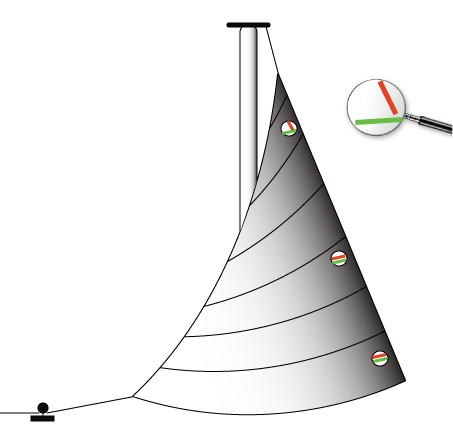
Figure 3a: The jib fairlead is positioned too far aft, opening the upper leech and spilling air out. The upper telltale flutters forward because the wind is choked off from that part of the sail. This is corrected by moving the fairlead forward
Figure 3a illustrates a sail with its lead too far aft, with the upper sail presented to the wind at too broad an angle. Insufficient airflow and turbulence cause the upper windward (red) jib telltale to dance forward while the middle and lower stream back nicely. The leech is allowed to open up and air spills out of the sail aloft. The loss of air pressure decreases left and drive, slowing the boat down.
Other sailing courses you might enjoy
Trusted by the world's leading sailing companies
From our students
4.9 out of 5 average across 75,308 student course ratings.
-
"I liked that there wasn’t pressure to rush. I could actually understand what I knew and what I still needed to work on."
Jamie, first-time boater
-
"By the time we chartered, I felt prepared instead of just approved. That made all the difference."
Alex, preparing for bareboat charter
-
"NauticEd helped me see boating as a skill I could build, not something I had to pass or fail."
Morgan, new boat owner