




















- Home
- About Us
- Sailing Courses
- Powerboat Courses
- SLC - International License
- Yacht Vacations
- Find an On-Water Instructor
- Practical Courses
- Fighting Childhood Cancer
- Free Courses Signup
- Student Benefits
- Gift a Sailing Course
- Sailing Opportunities
- Sailing Licenses and Certifications
- About the Sailing Certifications
- Sailing Blog & Helpful Articles
- NauticEd Podcast Series
- Yacht Charter Resources
- School Signup
- Instructor Signup
- Affiliate Signup
- Boat Sharing Software
- Sailing Industry Services
- Support & Contact
- Newsroom
- Privacy Policy

Safety at Sea | Online Sailing Course

Be Ready for Offshore Emergencies!
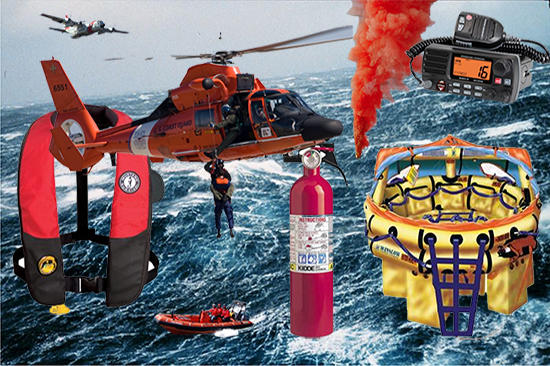
Prepare for the unexpected and sail with confidence offshore with the Safety at Sea online sailing course. Designed by Captain Ed Mapes, this comprehensive online course equips sailors with vital skills and knowledge to handle emergency situations effectively—MOB, jury-rigs, ditch bags, fire/flooding, heli-evac—in a structured 14-hour course.
✓ Stabilize rig & jury-rig sails, recover MOB using Quick-Stop, control flooding & fire, steer after rudder loss, prepare & deploy a ditch bag/raft, coordinate heli-evac safely, and more!
✓ For offshore cruisers, charter skippers, delivery crews, and confident coastal sailors
✓ Includes printable checklists and pocket cards—ditch bag, MOB, fire/flooding, helicopter hoist
✓ Is a Prerequisite for NauticEd's Captain Rank and Certification
✓ Recognition on your free online boating resume upon successful completion
✓ Lifetime access, including free updates online or in the NauticEd App
✓ 30-day Money Back Guarantee
Estimated Time: 14 hours
Price: $45 $39 Today (or $33 with the Captain Offshore Bundle of Courses)
Bonus: All NauticEd sailing students receive the free Basic Sail Trim and Nav Rules courses, free eLogbook and Boating Resume, and special discounts from our industry partners. What's Included >
What Students Say
✨AI generated from student reviewsStudents consistently call this Safety at Sea course practical, thorough, and confidence-building. They highlight a comprehensive curriculum grounded in real-world examples, with downloadable checklists for gear and protocols, helpful videos/animations, and quizzes that reinforce the details you might not think of until you’re offshore. Many note that it’s excellent “base prep” before an in-person class, while others appreciate how it covers both the essentials and the nuanced scenarios that matter when conditions turn loud and messy. Overall sentiment: lots of good material, clearly organized, immediately usable—and for several reviewers, the single most important course to take before heading offshore.
Why Take the Safety at Sea Course?
Register for the Safety at Sea online course and convert offshore “what-ifs” into clear, crew-ready preparation. This Safety at Sea course focuses on sea safety fundamentals you can brief, practice, and run under pressure—checklists, decision trees, and drills that raise your baseline before you cast off. You’ll build a practical ditch-bag, set up the right communications stack, and use printable quick-cards to standardize responses across your crew. Clean animations, scenario debriefs, and short assessments keep the offshore training efficient and grounded in real seamanship.
This Course is Perfect for You If:
- You own or skipper offshore-capable boats and want professional, written procedures everyone can follow.
- You’re moving from coastal to offshore and want a structured sea-survival foundation—without fluff.
- You charter in bluewater regions and want a proven safety framework for multi-day passages.
- You sail short-handed (couples/owner-operator) and need simple, repeatable crew roles for emergencies.
We guarantee both your satisfaction AND Lifetime access to any sailing course you buy from us
What You'll Learn in Safety at Sea
You’ll build real offshore readiness: from preventing problems to surviving worst-case scenarios. First, set your boat and crew up right with smart gear, comms, MOB beacons, and quick pre-departure checks. Next, learn to diagnose and stabilize failures underway: jury-rig a mast, steer without a rudder, triage engine issues, and control fire or flooding. Finally, drill the lifesaving moves: Quick-Stop MOB and safe recovery, abandon-ship with liferaft basics, essential first aid, and how to prep for a helicopter evacuation. Leave with checklists, decision trees, and practiced procedures you can execute under pressure.
View the Course Topics
Prepare & Prevent (before it breaks)
- Build a ditch bag and abandon-ship checklist
- Set up comms: VHF-DSC, AIS, EPIRB/PLB, satphone
- MOB beacons and a short crew safety brief
- Fit-out that matters: jacklines/tethers, preventer, storm sails, radar/searchlight, rescue tackle, manual bilge
- Two-minute pre-departure checklist and simple decision trees
- Rig failures: secure or cut away, gin pole, jury rig, sail again
- Steering: cable/hydraulic checks and emergency steering options
- Engine: fuel/filters/bleed, overheating, low oil/pressure triage
- Sail repair: quick fixes, larger panel work, spinnaker specifics
- Fire: sources, extinguisher selection, step-by-step protocol
- Flooding: find the source, pump strategy, collision mat/soft plugs
- MOB: Quick-Stop, deep-beam return, heave-to hold, safe recovery aboard
- Abandon ship: liferaft stowage, equipment, boarding under stress
- Medical: assess, treat common injuries/illness, when to escalate
- Helicopter evacuation: preparation, deck vs. raft transfer, static-discharge safety
Everything You Get with this Course
- The Safety at Sea online sailing course is required learning anytime you are sailing offshore.
- Available immediately online: start learning today at your own pace.
- Duration: Approximately 14 hours
- Unlimited Access: Lifetime access lets you review course materials anytime. Course updates are free.
- Recognition: Upon successful completion, you receive immediate recognition on your sailing resume that verifies for charter and insurance companies that you've completed the course.
- Qualification & Endorsement: This course is a prerequisite for and leads to additional qualification and endorsement for NauticEd's Captain Rank and Certification.
- Free Stuff: All NauticEd sailing students receive 2 free courses (Basic Sail Trim and Nav Rules), a free eLogbook and Boating Resume, and special discounts from our industry partners.
- Convenient Formats: Take the course on your desktop or laptop—and tablet or mobile phone using the free NauticEd App.
- View an excerpt from the Safety at Sea Course
About NauticEd
NauticEd is the leading provider of modern sailing education, combining online sailing courses with accredited on-water instruction. With over 300,000 students worldwide, NauticEd is the only U.S. sailing body recognized for meeting U.S. Coast Guard and NASBLA standards under the American National Standards for boating education.
Our online courses pair with on-water training, and your free eLogbook and sailing resume track each milestone. Whether you’re starting out or working toward higher endorsements, NauticEd gives you a clear, standards-aligned way to grow real skills.
Safety at Sea Foreword by Captain Ed Mapes
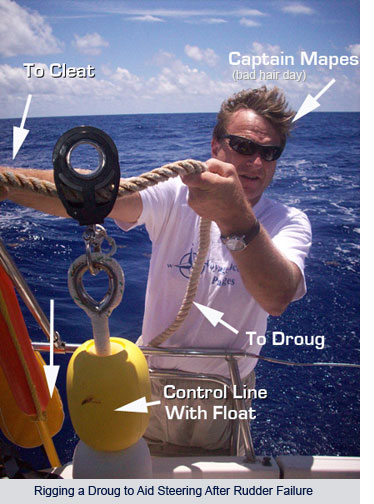
The traits of independence and self-sufficiency are absolute requirements in the mental makeup of those of us who venture offshore. The sailor who shudders at the thought of taking on repairs or coping with emergency situations should not take vessels or crews to sea. During my three decades of ocean sailing, I have discovered this incontrovertible fact: Murphy's Law is in full effect out there—things do go wrong, and unforeseen events come up in spite of the best intentions and most meticulous preparations. I know that this challenge is what draws me to sail the oceans, and it's also the reason that making landfall is such an indescribably proud moment. It is a feeling only experienced by those who dare to sail away from land, where only they can determine success...
Read the Foreword
The most capable skippers are those who give forethought and action to developing protocols and procedures to cope with situations that can arise well in advance of the sailing date, and outfit their vessels appropriately for eventualities at sea.
What would I do if the rudder broke? How would I cope if a shroud terminal cracked? Could I get the crew safely into the liferaft if the boat went down? Asking these questions in advance is a great way to make ready for the sea. We might not pre-fabricate replacements for everything that could break, but the exercise provides us the chance to have materials and tools ready to build a rudder, for example. We could have a plan in mind to substitute for a shroud and keep the rig standing. We would know what goes wrong with a wind vane, what to look for, and how to return it to use.
Most mariners don't realize that we never even hear about the many crews aboard vessels that had their share of problems offshore. Situations were evaluated, repairs were completed, and they made landfall quietly and efficiently - this was done as a normal course of passage making. These able sailors had the skills, materials, and a plan to cope - having merely to carry out the work to get back on course. They understand that overcoming obstacles is a normal part of blue-water sailing.
Taking stock of our boats with thorough inspections and considering what can go wrong is an exercise that helps skippers respond to trouble on the water. Ready to Sail, my first book, was written to help mariners conduct thorough, systematic vessel inspections in their efforts to ensure seaworthiness and preparation.
Protocols are sets of steps to be taken when situations or mishaps threaten the ship. The finest skippers not only formulate given protocols but extend their responsibility to teach those procedures to crewmembers before leaving the harbor. This preparation and the knowledge gained during the process not only makes the skipper more capable and seamanlike but also lends credibility to his abilities and fosters confidence in the whole ship's company. The crew's proficiency and confidence levels are enhanced when they understand that protocols are in place for all contingencies. That confidence is a key ingredient to alleviating fear and anxiety that can be detrimental to performance.
My Safety at Sea online course addresses the protocols that have proven effective for my crews—not merely in theory or during classroom sessions but during—thousands of miles at sea.
If you're considering venturing more than 20 miles offshore, you NEED the information in this course.
View Safety at Sea Course excerpt
Student Reviews
David S.
2026, 24 Sep. 22:09
great modules on safety!!
Kim D.
2026, 13 Sep. 02:22
fairly straight forward. Some specific knowledge mixed with common sense.
Kyriakos P.
2026, 26 Aug. 12:03
Really good insight on different scenarios
Timothy O.
2026, 10 Aug. 21:11
The detailed information on how analyze engine fuel and water systems is awesome/valuable!! Can’t wait to take the diesel mechanics course!
Jim M.
2026, 30 Apr. 04:04
Great Review of Safety at Sea.
Anthony H.
2026, 27 Apr. 19:39
Well Worth doing! Gives you insight every skipper should have
Sara M.
2026, 27 Apr. 17:25
Everything!
Cliff a.
2026, 09 Apr. 19:35
Excellent course material. Picked up on several topics regarding safety at sea that hadn't heard or read about before.
Bern E.
2026, 04 Apr. 19:52
This is a very well rounded and extensive course on safety at Sea. All modules are well laid out and informative.
Gilbert B.
2026, 02 Apr. 18:08
Succinct. Comprehensive. Keen practical focus.
Cameron G.
2026, 27 Feb. 02:13
There was a lot of details information that will undoubtably save lives. Thank you.
David T.
2026, 01 Feb. 08:09
Excellent and comprehensive overview of topics that deserve close attention, continued study and practical experience with further course work.
List Price: $45.00 Price: $39.00 You Save: $6.00 (13%)
Excerpt from the course
Expand Excerpt from the courseFrom Module 9: Crew Overboard
Reacting quickly also provides an enormous boost to the victim who sees the boat maneuver quickly rather than continuing to sail in the opposite direction.
Make the tack, and if at all possible and the seas are moderate enough to allow, execute the Quick Stop Maneuver shown in the video below.
The Quick Stop Maneuver
From Module 2: Jury Rigging
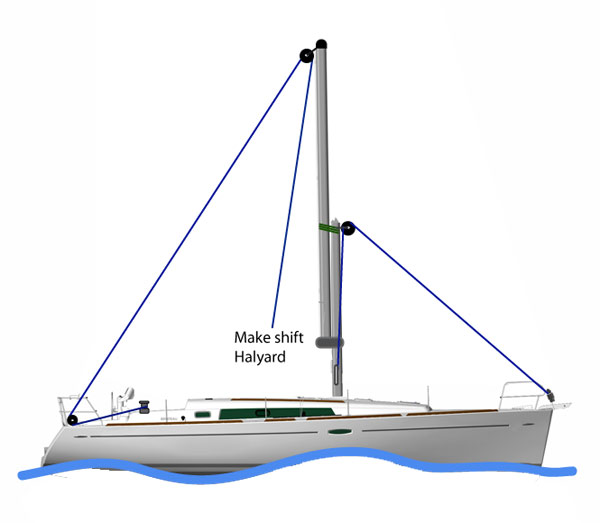
Jury rigging a set of sails will be necessary if the engine fails or you're beyond fuel range to the nearest port. There are some principles that apply to boats in general, but how to proceed depends on the circumstances. If a mast stub remains, it's probably broken just above the lower shrouds; above or below the first spreaders. This stub can be a great benefit, enabling three possible strategies that could be used:
- Connect a shackle at the upper end of the stub with lashings (icicle hitch) or directly with screws.
- Attach blocks to the outboard end of the boom, and fold the boom upward against the mast stub to serve as a spar (Figure 5).
- Hoist the spinnaker pole to the upper limits of the track to function as a mast.
From Module 11: Helicopter Evacuation
Once in position, a rescue basket or litter, with an attached trailing line, will be lowered to your deck from the chopper (Figure 4).
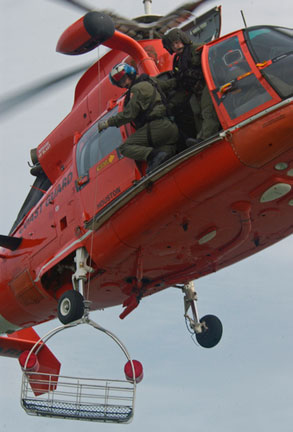
Figure 4: A rescue basket is lowered from the helicopter.
Courtesy of U.S. Coast Guard.
A powerful static electrical charge builds up within the basket and trailing line as they are lowered. These must make contact with the deck to dissipate those charges before touching them to begin positioning the patient.
Other sailing courses that you might enjoy
Trusted by the world's leading sailing companies
From our students
4.9 out of 5 average across 75,232 student course ratings.
-
"I liked that there wasn’t pressure to rush. I could actually understand what I knew and what I still needed to work on."
Jamie, first-time boater
-
"By the time we chartered, I felt prepared instead of just approved. That made all the difference."
Alex, preparing for bareboat charter
-
"NauticEd helped me see boating as a skill I could build, not something I had to pass or fail."
Morgan, new boat owner